 Loopy Panda
How to Crochet for Beginners
To start crocheting, buy one ball of smooth, light-coloured worsted yarn and a 5 mm (H-8) hook. Make a slip knot, crochet a chain of about 15, then work rows of single crochet back along it, turning at the end of each row. Once your rows stay the same width, try a simple square, scarf or granny square.
What you need
- Worsted weight (4, Medium) yarn in a smooth, light colour; cotton or acrylic both work
- 5 mm (H-8) crochet hook, or the size printed on the yarn label
- Scissors
- Tapestry (yarn) needle with a large eye
- 2–4 stitch markers (a safety pin or scrap of yarn also works)
Your first crochet session
- Get the right starter suppliesChoose a smooth yarn you can see each stitch in. Avoid black, very dark, fuzzy, bouclé or glittery novelty yarn for now. The hook size in mm matters more than the letter; see the hook size chart and the yarn weight chart.
- Make a slip knotAbout 15 cm (6 in) from the end, cross the yarn over itself to make a loop. Reach through the loop, pull a bit of the working yarn (the end coming from the ball) through it to form a new loop, and put that loop on the hook. Gently pull the two yarn ends to snug it around the hook: firm, but loose enough to slide.
- Hold the hook and yarnHold the hook in your dominant hand like a pencil or like a knife; both are correct. With the other hand, wrap the working yarn over your index finger and hold the work just below the hook with your thumb and middle finger. The index finger controls tension. Left-handed crocheters mirror everything and work from left to right.
- Crochet a chainYarn over (wrap the yarn over the hook from back to front) and pull it through the loop on the hook. That is one chain. Make about 15. Keep them even and not too tight, because you will work into them next.
- Work your first row of single crochetSkip the first chain next to the hook and insert the hook into the second chain from the hook. Yarn over, pull up a loop (2 loops on hook), yarn over, pull through both loops. That is one single crochet. Work one in each chain to the end.
- Turn and keep goingAt the end of the row,
ch 1and turn the work. The chain 1 does not count as a stitch. Work 1 single crochet into each stitch of the row below, starting in the first stitch. Count your stitches every row; the number should not change. - Fasten offWhen the piece is as long as you want, cut the yarn with a 10–15 cm (4–6 in) tail, pull it through the loop on the hook, and weave the ends in with a tapestry needle. See how to fasten off and hide ends.
- Learn to read a patternPatterns are written in abbreviations like
sc,incand(sc 2, inc) ×6 (24). Check whether the pattern uses US or UK terms, then read our guides to written patterns and crochet charts.
What is crochet?
Crochet is a way of making fabric from yarn with a single hook. You pull loops of yarn through other loops, one stitch at a time, and there is only ever one live loop on the hook, so a mistake is easy to undo: pull the yarn and the stitches come out. The same few stitches make blankets, hats, bags, lace and the small stuffed toys called amigurumi.
Choosing your first yarn and hook
Start with a smooth, light-coloured worsted (medium, weight 4) yarn in cotton or acrylic, and the hook size printed on its label, usually 5 mm (H-8). A light colour lets you see each stitch; smooth yarn does not split. Leave fluffy, dark and very thin yarns for later.
Hook sizes are named differently in the US, the UK, Japan and China, but the size in millimetres is always the same. See the hook size chart, the yarn weight chart and, if you want to make toys, the best yarn for amigurumi.
The basic stitches, one by one
Every crochet pattern is built from a handful of stitches. Each one below has a short real-speed clip of a single stitch; the link takes you to the full step-by-step page with photos, common mistakes and a left-handed version. Learn them in this order: each is the one before with one extra step.
Chain (ch)
Yarn over and pull through the loop on the hook. A row of chains is the foundation of most projects, and chains also make the spaces in lace and granny squares. How to chain.
Single crochet (sc)
Insert the hook, yarn over, pull up a loop (2 loops), yarn over and pull through both. It is short and dense, and almost every amigurumi is made of it. In UK patterns it is called double crochet. How to single crochet.
Slip stitch (sl st)
Insert the hook, yarn over and pull through the stitch and the loop on the hook in one go. It adds almost no height, so it is used to join rounds and move along the work. How to slip stitch.
Half double crochet (hdc)
Yarn over first, insert, pull up a loop (3 loops), yarn over and pull through all 3. About twice as tall as single crochet. How to half double crochet.
Double crochet (dc)
Yarn over, insert, pull up a loop (3 loops), then pull through 2 loops twice. Tall and quick: granny squares, blankets and shawls. In UK patterns it is called treble. How to double crochet.
Treble crochet (tr)
Yarn over twice, insert, pull up a loop (4 loops), then pull through 2 loops three times. Used for lace, petals and tall edges. How to treble crochet.
Working in the round
Hats, coasters and toys are worked in rounds instead of rows. Most start with a magic ring: a loop of yarn you crochet into and then pull closed, so the centre has no hole. Then you grow a flat circle by adding the same number of stitches every round.
Increase and decrease
To make a piece wider, work 2 stitches into the same stitch: an increase. To make it narrower, join 2 stitches into 1: a decrease; in amigurumi the invisible decrease is neater. These two moves are all the shaping a ball, a head or a hat needs.
Front loop, back loop and other variations
Normally you insert the hook under both top loops of a stitch. Going under only the back loop or only the front loop leaves a ridge, which patterns use for texture, ribbing and to mark where a piece changes direction. See back loop only. Combining basic stitches gives the popular textured stitches: the moss stitch, the V-stitch and the blanket stitch.
How to read a crochet pattern
Patterns are written in abbreviations such as sc, inc and (sc 2, inc) ×6 (24), or drawn as symbol charts. First check whether the pattern uses US or UK terms, because the same names mean different stitches. Then see how to read a written pattern, how to read a chart and the abbreviations in 10 languages. Many lovely patterns are only published in Chinese or Japanese; our guide to Chinese crochet patterns shows how to follow them without speaking the language.
Left-handed crochet
Left-handers hold the hook in the left hand and work from left to right; everything else is the same. Each basic stitch page has a mirrored video you can copy hand for hand: single crochet, half double, double crochet, slip stitch and the magic ring.
What to learn next, in order
Each skill builds on the one before. Links go to full step-by-step pages.
| Order | Skill | Why it matters |
|---|---|---|
| 1 | Chain (ch) | Starts almost every project and makes spaces in lace and granny squares |
| 2 | Single crochet (sc) | The shortest basic stitch; dense fabric and all amigurumi |
| 3 | Slip stitch (sl st) | Joins rounds and moves the yarn without adding height |
| 4 | Half double crochet (hdc) | A bit taller and faster than sc; hats and blankets |
| 5 | Double crochet (dc) | Tall, quick stitch; granny squares and blankets |
| 6 | Working in the round | Circles, coasters, hats and every amigurumi |
| 7 | Increase and decrease | Shaping: making a piece wider or narrower |
All the basic stitches are compared side by side in crochet stitches for beginners.
Good first projects
Five small projects in the order most beginners make them. The yarn and hook are a good starting choice; the times are a rough guide for a first attempt, and you will get faster quickly.
| Project | What it teaches | Yarn | Hook | Time (about) |
|---|---|---|---|---|
| A practice square or dishcloth in single crochet rows | Even edges, turning and counting stitches | Cotton, worsted (#4) | 5 mm (H-8) | 1–2 hours |
| A flat circle coaster | Working in the round and increasing | Cotton, worsted (#4) | 4–5 mm | 30–60 minutes |
| A granny square | Rounds, chain spaces and colour changes | Acrylic or cotton, worsted (#4) | 5 mm (H-8) | 30–45 minutes for 4 rounds |
| A simple scarf in half double or double crochet rows | Tension over a long piece | Acrylic, worsted (#4) | 5–5.5 mm | 6–10 hours |
| A small amigurumi ball | Magic ring, spiral rounds, increases, invisible decreases and stuffing | Cotton, DK (#3) or worsted (#4) | 0.5–1 mm smaller than the label, e.g. 3.5 mm for DK | About 1 hour |
When the ball feels easy, try our maker's own pattern, Pip the big-eyed mouse, or follow amigurumi for beginners step by step.
Beginner problems and quick fixes
- My piece is getting wider or narrower. You are adding or missing stitches at the ends of rows. Put a stitch marker in the first and last stitch of each row. More fixes in why is my crochet curling.
- My stitches are too tight to get the hook into. Relax the yarn over your index finger, and make each loop around the thick part (shaft) of the hook, not the narrow throat.
- My chain is tighter than my rows. Make the foundation chain with a hook one size bigger, then switch back.
- I can't tell where the next stitch is. Each stitch top looks like a sideways V. Insert the hook under both strands of the V unless the pattern says otherwise.
- Gaps and holes everywhere. Your tension is loose for the hook. Try a hook half a size smaller, see crochet tension, and how to undo mistakes.
Basic crochet stitch chart
Names and abbreviations are in US terms, with the UK name alongside. The turning chain is the number of chains usually made at the start of a row to reach the height of that stitch.
| Stitch (US) | UK name | Abbr. (US) | Height / turning chain | Yarn overs before inserting hook | Used for | Chinese |
|---|---|---|---|---|---|---|
| Chain | chain | ch | — | 0 | Foundation rows, spaces, turning chains | 锁针 |
| Slip stitch | slip stitch | sl st | Almost no height | 0 | Joining rounds, moving across stitches, neat edges | 引拔针 |
| Single crochet | double crochet (dc) | sc | Shortest basic stitch / ch 1 (does not count) | 0 | Dense fabric, amigurumi, edgings, dishcloths | 短针 |
| Half double crochet | half treble (htr) | hdc | Between sc and dc / ch 2 | 1 | Hats, blankets, quick fabric that is still fairly solid | 中长针 |
| Double crochet | treble (tr) | dc | Taller than hdc / ch 3 | 1 | Granny squares, blankets, open and lacy fabric | 长针 |
| Treble crochet | double treble (dtr) | tr | Tallest of the six / ch 4 | 2 | Lace, tall rows, some flower petals | 长长针 |
Whether a turning chain counts as a stitch depends on the pattern. Always check its notes. For the full name conversion, see US vs UK crochet terms, and for chart symbols see the crochet symbol table.
How each stitch is made, in one line
- Chain: yarn over, pull through the loop on the hook.
- Slip stitch: insert hook, yarn over, pull through the stitch and the loop on the hook in one motion.
- Single crochet: insert hook, yarn over, pull up a loop (2 loops), yarn over, pull through both.
- Half double crochet: yarn over, insert hook, yarn over, pull up a loop (3 loops), yarn over, pull through all 3.
- Double crochet: yarn over, insert hook, yarn over, pull up a loop (3 loops), then [yarn over, pull through 2] twice.
- Treble crochet: yarn over twice, insert hook, yarn over, pull up a loop (4 loops), then [yarn over, pull through 2] three times.
Beginner stitch variations
These are not new stitches, but ways of working the basic ones. You will meet them in the first few patterns you try.
| Variation | Abbr. | What it does | Learn it |
|---|---|---|---|
| Increase | inc | 2 stitches in one stitch; makes the piece wider | Single crochet increase |
| Decrease | dec, sc2tog | 2 stitches worked together into one; makes the piece narrower | Invisible decrease |
| Back loop only | BLO | Work into the back loop only; makes a ridge or a ribbed texture | Back loop only |
| Magic ring | MR | An adjustable starting ring for working in the round | Magic ring |
Chart symbols on this page
Frequently asked questions
Which crochet stitches should I learn first, and in what order?
Learn them in this order: chain, single crochet, slip stitch, half double crochet, double crochet and treble crochet, then the magic ring, increases, decreases and fastening off. Each stitch adds one more yarn over to the one before, so this order builds on what your hands already know. Every step has a narrated video.
How do I start crocheting?
Buy smooth worsted yarn and a 5 mm hook, make a slip knot, chain 15, and work rows of single crochet back along the chain, turning with a chain 1 at the end of every row. That first swatch teaches the motions every other stitch uses.
What size crochet hook should a beginner use?
A 5 mm (H-8) or 5.5 mm (I-9) hook with worsted weight yarn is a comfortable size for learning. Very small hooks and thin yarn make stitches hard to see.
Is crochet easier than knitting?
Many people find crochet easier to start because there is only one live loop on the hook at a time, so a dropped stitch is easy to fix. Both are learnable; it depends on the person.
What is the first stitch to learn in crochet?
The chain, then single crochet. Almost every other stitch is a taller version of single crochet with extra yarn overs.
Should I learn US or UK crochet terms?
Learn the terms your patterns use. Most online patterns use US terms. The same names mean different stitches: a UK double crochet is a US single crochet.
How long does it take to learn to crochet?
Most beginners can make a chain and rows of single crochet in their first session. Even tension and neat edges take more practice, so start with small, forgiving projects.
Can left-handed people crochet?
Yes. Hold the hook in the left hand and work from left to right. Written patterns work the same way; photos and charts just appear mirrored.
What are the basic crochet stitches?
Chain, slip stitch, single crochet, half double crochet, double crochet and treble crochet. They differ only in how many times you yarn over and how you finish the stitch, so each one is the previous one plus one step.
What is the easiest crochet stitch?
The chain is the simplest movement, and single crochet is the easiest stitch for making real fabric. Start with those two.
In what order should I learn crochet stitches?
Chain, single crochet, slip stitch, half double crochet, double crochet, then treble. Each one adds a step to the one before, so the order makes the next stitch easier.
Why is a UK double crochet different from a US double crochet?
The two systems name stitches differently. A UK double crochet is a US single crochet, and a UK treble is a US double crochet. Check which terms your pattern uses before starting.
Which crochet stitch is best for amigurumi?
Single crochet. It makes the tightest fabric, so stuffing does not show through. Most amigurumi patterns use it for almost every round.
Which basic stitch is fastest for a blanket?
Taller stitches cover more ground per stitch, so double crochet and treble crochet grow faster than single crochet. The fabric is also looser and drapier.
Save it for later
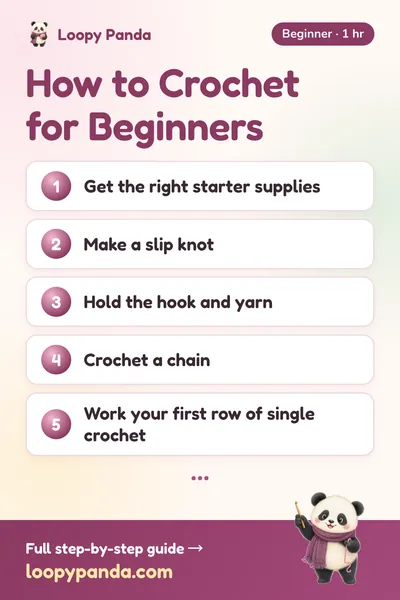
Pin this guide to your Pinterest board so it's there when you pick up your hook.
Save to Pinterest
Tell me when new free patterns are out
We'll send you a short email when a new free pattern or tutorial goes up. No spam.
Thank you! You're on the list. We'll email you when a new free pattern is out.
Please enter a valid email address.
Please tick the box to agree to receive our emails.
Too many tries. Please wait a few minutes and try again.
Something went wrong. Please try again later.
New short videos every week, too, on YouTube