 Loopy Panda
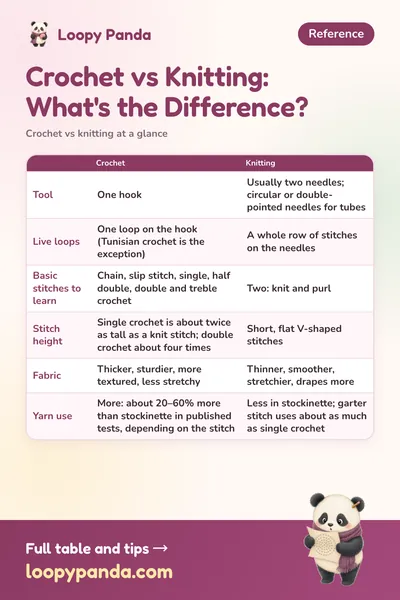
Crochet vs Knitting: What's the Difference?
Crochet uses one hook and keeps one live loop at a time; knitting uses two needles and keeps a whole row of live stitches. Crochet fabric is usually thicker and sturdier, knitting stretchier and drapier. Crochet is usually faster and easier to undo, but uses more yarn: published tests range from about 20% to 60% more, depending on the stitch.
Crochet vs knitting at a glance
Both crafts make fabric by pulling loops of yarn through other loops. The differences come from the tool and from how many loops are live (not yet secured) at once.
| Crochet | Knitting | |
|---|---|---|
| Tool | One hook | Usually two needles; circular or double-pointed needles for tubes |
| Live loops | One loop on the hook (Tunisian crochet is the exception) | A whole row of stitches on the needles |
| Basic stitches to learn | Chain, slip stitch, single, half double, double and treble crochet | Two: knit and purl |
| Stitch height | Single crochet is about twice as tall as a knit stitch; double crochet about four times | Short, flat V-shaped stitches |
| Fabric | Thicker, sturdier, more textured, less stretchy | Thinner, smoother, stretchier, drapes more |
| Yarn use | More: about 20–60% more than stockinette in published tests, depending on the stitch | Less in stockinette; garter stitch uses about as much as single crochet |
| Speed | Usually faster, because each stitch is taller | Usually slower |
| Dropped stitch | Rarely a problem; the stitches below stay put | Can unravel the knitted fabric |
| Undoing mistakes | Easy: pull the yarn back to the error | Harder: the stitches are interlocked, so ripping back takes longer |
| Working in the round | Any hook | Needs circular needles or 3–5 double-pointed needles |
| Often used for | Blankets, amigurumi, home decor, lace and doilies | Sweaters, socks, gloves, and other garments |
| Made by machine? | No commercial machine makes true crochet; it is made by hand | Yes: knitting machines exist and knitwear is mass-produced |
Sources differ on how much more yarn crochet uses, so the range is wide; the next section shows the actual test numbers.
Does crochet use more yarn than knitting?
Usually yes, but how much depends far more on the stitch than on the craft. Two published swatch tests compared stitches made from the same yarn with a 6 mm hook and 6 mm needles. The percentages below are worked out from their measurements and show how much more yarn each stitch needs than knitted stockinette for the same area.
| Stitch | Test 1: chunky yarn, 20 × 20 stitch swatches (by weight per area) | Test 2: worsted acrylic, 10 cm squares (by length) |
|---|---|---|
| Knitted stockinette | baseline | baseline (9.10 m) |
| Knitted garter stitch | about 46% more | about 35% more |
| Single crochet | about 60% more | about 35% more |
| Half double crochet | about 36% more | not tested |
| Double crochet | about 27% more | about 20% more |
| Tunisian crochet | not tested | about 44% more |
Other sources give a rule of thumb of 25–30% more yarn for crochet, and some say most crochet uses far less than a third more. What all of them agree on: single crochet is the densest and uses the most yarn, taller stitches use less, and knitted stockinette uses the least. Knitted garter stitch uses about as much yarn as single crochet. Your own tension and hook size change the numbers too, so for a real project make a swatch or use the yarn calculator.
Why crochet fabric is thicker and sturdier
Each crochet stitch is several loops wrapped around each other and finished before the next one starts, so the fabric has a more structured feel. Knitted stitches are linked in columns, each held by the stitch above it and holding the one below, and knitted fabric is thinner, smoother and more flexible. That is why knitting is the classic choice for sweaters and socks that need to stretch, and crochet for blankets, bags and toys that should hold their shape.
This is a tendency, not a rule. Crochet in lighter, softer yarn or with a bigger hook can be drapey enough for garments, and thick yarn makes a sturdy fabric in either craft.
Which is easier: crochet or knitting?
Both feel awkward for the first few hours, and each is easier in a different way.
- Crochet is easier to manage and fix. You hold one hook, and only one loop is live, so if the hook slips out nothing unravels. To undo a mistake you take the hook out and pull the yarn back to the error (see how to frog crochet), then put the loop back on the hook.
- Knitting has fewer stitches to learn. At the start there are only knit and purl, and the live stitches sit in a neat line on the needle, so you always know where the next stitch goes.
- Crochet asks you to read your stitches. You have to see where to insert the hook each time, and count stitches at first. Our counting guide helps.
- Both need yarn tension. In crochet the non-dominant hand controls the yarn; in knitting you can hold the yarn in either hand.
Why amigurumi is almost always crocheted
The word amigurumi covers knitted and crocheted toys, but most are crocheted. Crochet works in the round with a single hook, with no circular or double-pointed needles, and you can add or join stitches almost anywhere, which makes 3D shapes like balls, ears and limbs straightforward. Tight single crochet with a small hook gives a stiff, sturdy fabric with tiny gaps, so the stuffing does not show. Toys can be knitted too, but shaping them takes more advanced knitting skills.
Can crochet be made by machine?
Not in normal production. Knitting can be done by machine and knitted clothes are mass-produced, but crochet has to be done by hand, so a crocheted piece you buy was almost certainly made by a person. Machine-made “crochet look” lace and prints are other fabrics made to look like crochet. Researchers have built a prototype crochet machine, but it is a research project, and its fabric has a technical front and back because it forms every stitch from one side.
Which should I learn first?
| If you want to… | Start with |
|---|---|
| Make stuffed toys (amigurumi) | Crochet. Start with amigurumi for beginners |
| Make socks, fitted sweaters or stretchy ribbing | Knitting |
| Finish a first project quickly (blanket, scarf, granny squares) | Crochet |
| Learn as few stitches as possible at first | Knitting (knit and purl) |
| Fix mistakes easily and put work down mid-row | Crochet |
| Spend as little as possible on tools | Crochet: hooks usually cost less than needles, and you need fewer |
You do not have to choose forever. Many people do both, and knitters use a crochet hook too, to repair dropped stitches. If you choose crochet, start with how to crochet for beginners and the basic stitches.
Chart symbols on this page
Frequently asked questions
What is the main difference between crochet and knitting?
Crochet uses one hook and has only one live loop at a time, finishing each stitch before the next. Knitting uses two needles that hold a whole row of live stitches. Everything else, from fabric feel to how easy mistakes are to fix, follows from that.
Is crochet easier than knitting?
Many people find crochet easier to start because there is only one tool and one live loop, so a dropped stitch is easy to fix. Knitting has only two basic stitches to learn. It depends on the person; both are learnable.
Does crochet use more yarn than knitting?
Usually. Two published tests found crochet stitches used about 20–60% more yarn than knitted stockinette for the same area, and a common rule of thumb is 25–30%. Single crochet uses the most; taller stitches like double crochet use less. Knitted garter stitch uses about as much as single crochet.
Is crochet faster than knitting?
Usually, because crochet stitches are taller: a single crochet is about twice the height of a knit stitch and a double crochet about four times, so each stitch covers more fabric. Speed also depends on how practised you are.
Can crochet be done by a machine?
No commercial machine makes true crochet, so crochet is made by hand. Knitting machines are common. Machine-made crochet exists only as a research prototype.
Can I use the same yarn for crochet and knitting?
Yes. Any yarn can be knitted or crocheted with the right hook or needle size. Lofty, thick wool often suits knitting better, and thin, tightly spun yarn helps crochet get the firm fabric amigurumi needs; see the yarn weight chart.
Save it for later
Pin this guide to your Pinterest board so it's there when you pick up your hook.
Save to Pinterest
Tell me when new free patterns are out
We'll send you a short email when a new free pattern or tutorial goes up. No spam.
Thank you! You're on the list. We'll email you when a new free pattern is out.
Please enter a valid email address.
Please tick the box to agree to receive our emails.
Too many tries. Please wait a few minutes and try again.
Something went wrong. Please try again later.
New short videos every week, too, on YouTube