 Loopy Panda
Amigurumi for Beginners
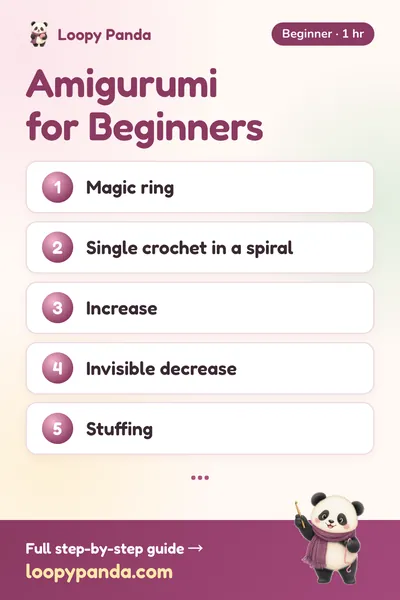
To start amigurumi, learn eight skills in order: the magic ring, single crochet in a spiral, increases, invisible decreases, stuffing, closing the last round, sewing parts together and adding eyes. Practise them all on a simple ball: 6, 12, 18 and 24 stitches, four plain rounds, then 18, 12 and 6, stuffing before the end.
What Is Amigurumi?
Amigurumi is the Japanese word for small stuffed toys that are crocheted or knitted. It combines ami (crocheted or knitted) and nuigurumi (stuffed toy). It is pronounced ah-mee-goo-roo-mee. Most amigurumi are crocheted in tight single crochet worked in a spiral, with a small hook, then stuffed with fiberfill.
What you need
- Worsted weight (4, Medium) or DK (3, Light) yarn in a smooth, light colour
- Crochet hook smaller than the label suggests, such as 3.5–4 mm for worsted or 2.5–3.5 mm for DK
- Polyester fiberfill stuffing
- Stitch marker
- Tapestry needle and scissors
- Safety eyes (optional; embroider eyes for toys for children under 3)
The core skills, in order
- Magic ringAlmost every amigurumi piece starts with a magic ring and 6 single crochet, pulled closed so there is no hole in the centre.
- Single crochet in a spiralWork single crochet round and round without joining. Put a stitch marker in the first (or last) stitch of each round and move it up every round, so you always know where a round starts.
- IncreaseAn increase (
inc) is 2 sc in one stitch. Increasing 6 times per round keeps the piece growing as a flat circle; stopping the increases makes the sides curve up. - Invisible decreaseThe invisible decrease works 2 stitches together through the front loops only, so it does not leave a bump or a gap. Decreasing 6 times per round closes a piece.
- StuffingAdd polyester fiberfill in small pieces before the opening gets too small, and top it up just before closing. See how to stuff amigurumi.
- Closing the last roundCut the yarn, pull it through, then thread it on a tapestry needle and pass it through the front loop of each remaining stitch. Pull like a drawstring to close the hole and hide the tail inside. See fastening off.
- Sewing parts togetherLeave a long tail on arms, ears and legs, pin them in place, and whip stitch them on. See how to sew amigurumi parts together.
- EyesInsert safety eyes before you stuff and close the head, and lock the washers from the inside. For toys for babies and children under 3, embroider the eyes with yarn instead.
First practice piece: a simple ball
This ball uses skills 1 to 6. It is worked in a continuous spiral in single crochet. The number in brackets is the stitch count at the end of each round.
| Round | Instructions (US terms) | Stitches |
|---|---|---|
| 1 | 6 sc in a magic ring | 6 |
| 2 | inc in each st (6 inc) | 12 |
| 3 | (sc 1, inc) ×6 | 18 |
| 4 | (sc 2, inc) ×6 | 24 |
| 5–8 | sc in each st (4 plain rounds) | 24 |
| 9 | (sc 2, dec) ×6 | 18 |
| 10 | (sc 1, dec) ×6; stuff the ball firmly | 12 |
| 11 | dec ×6; add a little more stuffing if needed | 6 |
| Finish | Fasten off, weave the tail through the front loops of the last 6 stitches, pull closed, hide the tail inside | — |
If you want to practise safety eyes too, insert them after round 8, before stuffing. In a Chinese pattern this ball would be written 环起6X → 6V → (1X,1V)×6 → (2X,1V)×6 → 第5-8圈24X → (2X,1A)×6 → (1X,1A)×6 → 6A; see how to read Chinese crochet patterns.
What to make after the ball
- An egg or a simple body shape. Same as the ball but with more plain rounds in the middle.
- A toy with a few parts, such as a simple animal with a round head and small ears. This adds sewing and eye placement.
- A toy with a colour change, such as a striped body.
- Read how to read an amigurumi pattern before your first full pattern, so abbreviations and repeats are clear.
Common beginner problems
- Stuffing shows through. The fabric is too loose. Go down a hook size. See amigurumi gaps and holes.
- The ball is lumpy or pointy. Stuff in smaller pieces and roll it between your hands. Pointed tops can also come from stacked increases.
- The piece leans or twists. This is normal in a spiral; see why amigurumi leans.
- Lost count. Count at the end of every round and check it against the number in brackets before moving on.
What the word amigurumi means
| Part | Japanese | Meaning |
|---|---|---|
| ami | 編み | crocheted or knitted (from the verb 編む, amu, to knit or crochet) |
| -gurumi | from ぬいぐるみ (nuigurumi) | stuffed toy, plush doll |
| amigurumi | 編みぐるみ | a knitted or crocheted stuffed toy |
In English the word is used for both one toy and many: “an amigurumi” and “three amigurumi”. You will also see “amigurumis”. In Chinese the usual terms are 钩针玩偶 or 毛线玩偶.
How to pronounce amigurumi
Say it in five even syllables: ah-mee-goo-roo-mee. Japanese does not stress one syllable much more than the others, so avoid a strong English-style stress. The “r” is a light tap, close to the “d” sound in the American English “ladder”.
What makes amigurumi different from other crochet
- Tight single crochet. Almost everything is worked in single crochet, with a hook smaller than the yarn label suggests, so the fabric is dense and the stuffing does not show.
- Worked in a spiral. Pieces start with a magic ring and are crocheted in continuous rounds without joining, tracked with a stitch marker.
- Shaped by increases and decreases. Increases make the piece grow and decreases close it up, so spheres, cones and tubes form without sewing darts.
- Made in parts. Heads, bodies, arms and ears are usually crocheted separately, stuffed and sewn together.
- Small and cute. Many designs have oversized heads and simple faces, but there is no rule about size or subject.
What you need to make amigurumi
| Item | Typical choice | Notes |
|---|---|---|
| Yarn | Cotton, cotton blend, acrylic or plush | See best yarn for amigurumi |
| Hook | Often 2.5–4 mm for DK or worsted yarn | Smaller than the label suggests; see the hook size chart |
| Stuffing | Polyester fiberfill | See how to stuff amigurumi |
| Eyes | Safety eyes or embroidered eyes | Embroider for children under 3; see safety eyes |
| Stitch marker | Any removable marker | Marks the first or last stitch of each round |
| Tapestry needle | Blunt, large eye | For sewing parts and closing holes |
Chart symbols on this page
Frequently asked questions
Which basic skills should I learn first to start making amigurumi?
Learn eight skills in this order: the magic ring, single crochet in a spiral with a stitch marker, increases, invisible decreases, stuffing, closing the last round, sewing parts together and adding eyes. Practise all of them on a small ball before your first animal.
What is the easiest amigurumi for a beginner?
A ball. It uses the magic ring, increases, plain rounds, decreases, stuffing and closing, with no sewing. After that, try something with one or two sewn-on parts.
What hook size should I use for amigurumi?
Smaller than the yarn label suggests, so the fabric is tight. Common choices are 3.5–4 mm for worsted and 2.5–3.5 mm for DK. If stuffing shows through, go down a size.
Do I join rounds in amigurumi?
Usually not. Most amigurumi are worked in a continuous spiral with a stitch marker. Follow your pattern if it says to join with a slip stitch.
Should I start with plush yarn?
It is better to start with a smooth cotton, cotton blend or acrylic yarn. Plush and chenille yarns hide the stitches, which makes counting and finding the next stitch hard for a beginner.
Are safety eyes safe for babies?
For children under 3, embroider the eyes with yarn instead of using safety eyes or any small hard parts.
What does amigurumi mean in English?
It means a knitted or crocheted stuffed toy. The word joins the Japanese ami (knitted or crocheted) and nuigurumi (stuffed toy).
How do you pronounce amigurumi?
ah-mee-goo-roo-mee, five syllables with fairly even stress. The r is a light tap.
Is amigurumi crochet or knitting?
The word covers both, but most amigurumi today are crocheted, because crochet makes a firm fabric and shapes easily in the round.
Is amigurumi hard for beginners?
It is a good first project type because it uses mainly one stitch. The skills are learnable in order; see amigurumi for beginners.
What is the difference between amigurumi and a crochet plushie?
They mean almost the same thing. “Plushie” is often used for larger, softer toys, especially in plush yarn, while “amigurumi” is often used for smaller, firmly crocheted stuffed toys. Many people use the words interchangeably.
Save it for later
Pin this guide to your Pinterest board so it's there when you pick up your hook.
Save to Pinterest
Tell me when new free patterns are out
We'll send you a short email when a new free pattern or tutorial goes up. No spam.
Thank you! You're on the list. We'll email you when a new free pattern is out.
Please enter a valid email address.
Please tick the box to agree to receive our emails.
Too many tries. Please wait a few minutes and try again.
Something went wrong. Please try again later.
New short videos every week, too, on YouTube