 Loopy Panda
How to Crochet a Slip Stitch
A slip stitch (sl st) is the shortest crochet stitch. Insert the hook into the stitch, yarn over, and pull the yarn through the stitch and the loop on your hook in one motion. It adds almost no height, so it is used to join rounds, move to a new spot without adding height, and finish edges neatly.
What you need
- Yarn and a crochet hook in the size on the yarn label
- A small crocheted swatch or a foundation chain to practise on
Step by step
- Start with a loop on the hookYou should have one loop on your hook, for example after finishing a round or a chain.
- Insert the hookInsert the hook into the stitch the pattern names. To join a round, that is the first stitch of the round (or the top of the starting chain, if the pattern says so).
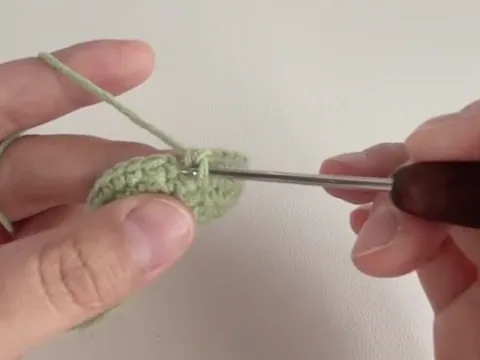
- Yarn overBring the yarn over the hook from back to front.
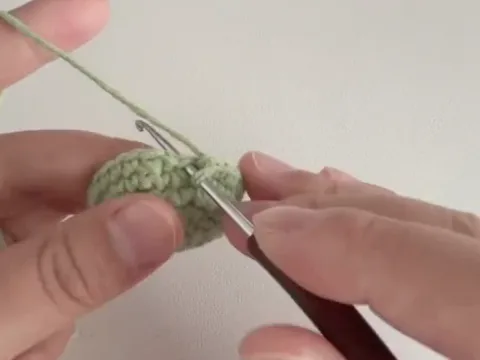
- Pull through everythingDraw the yarn through the stitch and straight through the loop on your hook in one movement. One loop remains on the hook. That is one slip stitch.
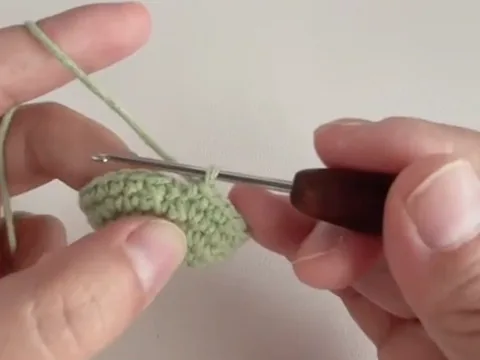
- Keep it looseSlip stitches tighten easily. Pull the new loop up a little before drawing it through, so you can work into the stitch later.
- ContinueWork the next slip stitch in the next stitch, or chain up and start the next round as the pattern says.
What slip stitches are used for
- Joining a round:
join with sl st to first sccloses a round into a ring before you start the next one. - Joining a chain into a ring: for example,
ch 6, sl st in first ch to form a ring. - Moving along a row without adding height, for example to reach the middle of a row.
- Finishing a spiral piece: many amigurumi patterns end with
sl st in next st, fasten offso the last round slopes down smoothly. - Surface slip stitch: worked on top of finished fabric to draw lines such as a mouth or stripes.
How the slip stitch appears in patterns
| Pattern style | What you will see | Meaning |
|---|---|---|
| US written | sl st or slst | Slip stitch |
| UK written | ss or sl st | Same stitch; UK patterns often shorten it to ss |
| Chinese written | 引 or 引拔 | 引拔针, slip stitch |
| Chart | A small filled dot | See the slip stitch symbol |
How to join a round with a slip stitch
When a pattern says join with sl st to first st, insert the hook into the top of the first stitch of the round you just finished, under both loops, yarn over and pull through the stitch and the loop on the hook. The round is now a closed ring.
Then chain up for the next round: chain 1 for single crochet, 2 for half double, 3 for double crochet. With single crochet the chain 1 does not count, so work the first stitch of the new round into the same stitch you joined into. Joined rounds leave a faint diagonal seam; if you would rather avoid it, see working in a spiral with a stitch marker.
Joining two pieces with slip stitch (slip stitch seam)
Slip stitch is also a quick way to join two crochet pieces, for example granny squares or the two halves of a flat shape. Hold the pieces together, insert the hook through the matching stitches of both pieces, yarn over and pull through both pieces and the loop on the hook. Repeat in each pair of stitches along the edge.
This makes a firm, slightly raised ridge. Work it on the wrong side if you want the ridge hidden, or on the right side as a decorative line. Going through the back loops only gives a flatter seam. For amigurumi parts such as arms and ears, sewing usually looks neater; see sewing amigurumi parts.
Slip stitch in the back loop (slip stitch ribbing)
Rows of slip stitch worked into the back loop only make a stretchy, knit-like rib, often used for hat brims and cuffs. Work each slip stitch under the back loop only, chain 1 and turn at the end of each row, and keep the tension loose: slip stitch fabric is dense and stops stretching if it is tight. A hook one or two sizes larger than usual helps. See back loop only.
Common mistakes
- Working a single crochet by accident. If you pull through the stitch first and then yarn over again, you have made a single crochet. In a slip stitch, the yarn goes through both in one pull.
- Too tight. A tight slip stitch join is hard to find and work into on the next round. Keep the loop loose.
- Counting the join as a stitch. The slip stitch that joins a round is usually not counted in the stitch total.
- Joining a spiral by mistake. Most amigurumi are worked in a continuous spiral with no joins. Only join with a slip stitch if the pattern says so.
If your slip stitches are too tight
- Use a bigger hook for slip stitch rows or slip stitch seams, one or two sizes up.
- Pull the loop up before drawing it through. Lift the new loop to the height of the loop on the hook, then pull it through.
- Do not tug the yarn after each stitch. Let the working yarn run freely over your finger.
- Cannot find the join on the next round? Put a stitch marker in the first stitch before you join, so you know where the round starts.
Left-handed slip stitch
Left-handers hold the hook in the left hand and the yarn in the right, and work from left to right. The steps are the same, only mirrored. The video below is the demonstration above flipped left to right, so you can copy it hand for hand.
Slip Stitch Symbol
The slip stitch symbol is a small filled dot. A slip stitch (sl st) adds almost no height; it is used to join rounds, move along a row, or finish off. In Chinese patterns it is 引拔针, often written simply as “引”.
| US name and abbreviation | Slip Stitch (sl st) |
|---|---|
| UK name and abbreviation | Slip stitch (ss) |
| Chinese name | 引拔针 (引针) |
| Chinese written shorthand | 引 / • |
| Japanese name | 引き抜き編み |
Is a slip stitch the same in US and UK patterns?
Yes, the stitch is the same. US patterns write sl st; UK patterns often write ss.
What does 引拔 mean at the end of a round?
It means join the round with a slip stitch into the first stitch. Amigurumi worked in a continuous spiral usually skips this.
Chart symbols on this page
Frequently asked questions
What does sl st mean in crochet?
sl st means slip stitch: insert the hook, yarn over and pull through the stitch and the loop on the hook in one movement. UK patterns often write it ss, and charts show it as a small filled dot.
Is a slip stitch the same in UK and US crochet?
Yes. The stitch is the same. US patterns write sl st; UK patterns often write ss.
What does 引拔 mean in a Chinese pattern?
引拔 (short for 引拔针, often just 引) is the slip stitch. At the end of a round it means join to the first stitch with a slip stitch.
Does a slip stitch count as a stitch?
A slip stitch that joins a round usually does not count. A row of slip stitches worked as fabric does count. Check the stitch count at the end of the round.
Should I join amigurumi rounds with a slip stitch?
Only if the pattern says so. Most amigurumi use a continuous spiral with a stitch marker, because joins leave a visible seam line.
What is the difference between a slip stitch and a single crochet?
A slip stitch pulls the yarn through the stitch and the loop on the hook in one step. A single crochet pulls up a loop first (2 loops on hook), then yarns over and pulls through both, so it is taller.
Save it for later
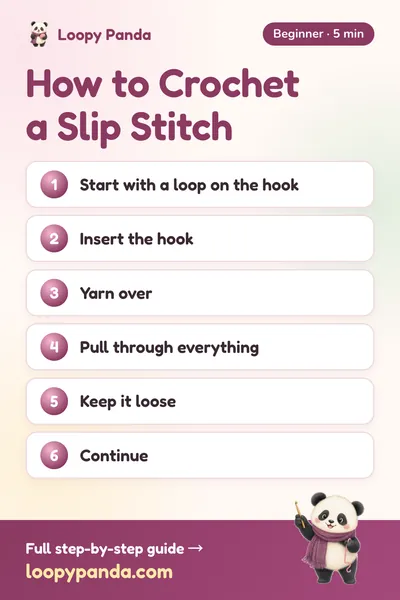
Pin this guide to your Pinterest board so it's there when you pick up your hook.
Save to Pinterest
Tell me when new free patterns are out
We'll send you a short email when a new free pattern or tutorial goes up. No spam.
Thank you! You're on the list. We'll email you when a new free pattern is out.
Please enter a valid email address.
Please tick the box to agree to receive our emails.
Too many tries. Please wait a few minutes and try again.
Something went wrong. Please try again later.
New short videos every week, too, on YouTube