 Loopy Panda
How to Fasten Off and Hide Yarn Ends

To fasten off, cut the yarn leaving a tail, then pull the tail all the way through the loop on your hook and tug to tighten. For an amigurumi, thread the tail on a tapestry needle, weave it through the front loops of the last round, pull to close the hole, then pass the needle through the piece and trim the tail so it disappears inside.
What you need
- Scissors
- Tapestry needle (blunt, with a large eye)
- Stuffing, if closing a stuffed piece
Step by step
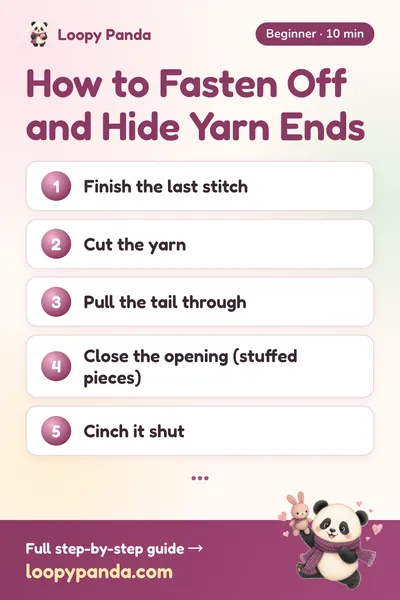
- Finish the last stitchComplete the last stitch the pattern gives. Many amigurumi patterns end with a slip stitch in the next stitch so the edge slopes down smoothly.
- Cut the yarnCut the yarn, leaving a tail. About 15 cm (6 in) is enough to weave in; leave 30 cm (12 in) or more if you will sew this piece to another.
- Pull the tail throughTake the hook out and pull the loop upward (or yarn over with the cut end and draw it through) until the whole tail passes through the last loop. Pull the tail firmly so the loop tightens.
- Close the opening (stuffed pieces)Finish stuffing first. Thread the tail onto a tapestry needle and insert it through the front loop of each remaining stitch, from the outside in, all the way around.
- Cinch it shutPull the tail gently but firmly. The front loops gather like a drawstring and the hole closes.
- Hide the tail insidePush the needle down through the closed centre and out somewhere else on the piece. Pull the yarn, squeeze the piece a little, and trim the tail close to the surface. When you let go, the end slips inside.
- Hide ends on flat piecesOn flat or open pieces, weave the tail through the backs of several stitches in one direction, then back the other way through different stitches before trimming.
Invisible fasten off for a neat edge
For open edges that will show, such as the rim of a hat or the edge of an ear, an invisible fasten off hides the step at the end of the round.
- After the last stitch, cut the yarn and pull the tail straight up through the last stitch (no knot needed).
- Thread the tail onto a tapestry needle.
- Do not join with a slip stitch. Insert the needle under both top loops of the first stitch of the round, from front to back.
- Insert the needle back down into the top of the last stitch you made, through its back loop, and pull until the new strand is the same size as a normal stitch top.
- Weave the tail in on the wrong side.
How fastening off appears in patterns
| Pattern style | What you will see | Meaning |
|---|---|---|
| US written | Fasten off, leaving a long tail for sewing | Cut the yarn with a long tail and pull through; keep the tail |
| US written | Fasten off and weave in ends | Cut, pull through, and hide the tail |
| UK written | Fasten off and sew in ends | The same; UK patterns often say “sew in” instead of “weave in” |
| Chinese written | 收针, 留长线, 收口, 藏线头 | Fasten off / leave a long tail / close the opening / hide the yarn end |
Common mistakes
- Closing through both loops. Going through both loops of each stitch makes a bulky, uneven closure. Front loops only gather more neatly.
- Tail too short to thread. Leave more than you think you need. A short tail is hard to weave and can work loose.
- Cutting the long sewing tail by habit. If the pattern says to leave a long tail, you will need it to attach the part.
- Ends working loose later. Change direction at least once when weaving, and weave slippery yarns (cotton, silky blends) a little further.
Chart symbols on this page
Frequently asked questions
What does fasten off mean in crochet?
It means ending your work: cut the yarn and pull the cut end all the way through the last loop so the stitches cannot unravel.
Is fastening off different in UK patterns?
No. UK patterns also say “fasten off”. For hiding the tails they often say “sew in ends” where US patterns say “weave in ends”.
What does 收针 mean in a Chinese pattern?
收针 means fasten off. 收口 means close the opening, 留长线 means leave a long tail for sewing, and 藏线头 means hide the yarn end.
How long should I leave the tail when fastening off?
About 15 cm (6 in) for weaving in. For pieces you will sew on, such as ears or arms, leave 30 cm (12 in) or more, or whatever the pattern says.
How do I close the hole at the end of an amigurumi?
Finish stuffing, thread the tail on a tapestry needle, pass it through the front loop of each remaining stitch, and pull tight like a drawstring. Then pass the needle through the piece and trim.
Save it for later
Pin this guide to your Pinterest board so it's there when you pick up your hook.
Save to Pinterest
Tell me when new free patterns are out
We'll send you a short email when a new free pattern or tutorial goes up. No spam.
Thank you! You're on the list. We'll email you when a new free pattern is out.
Please enter a valid email address.
Please tick the box to agree to receive our emails.
Too many tries. Please wait a few minutes and try again.
Something went wrong. Please try again later.
New short videos every week, too, on YouTube