 Loopy Panda
How to Read Chinese Crochet Patterns
Chinese amigurumi patterns are written with letters that look like chart symbols: X is a single crochet, V is an increase (2 sc in one stitch), A is a decrease (2 sc together), and the number in brackets is the stitch count. So (1X,1V)×6 (18) means “repeat (sc 1, inc 1) six times, 18 stitches”.
How to read one line of a Chinese pattern
- Find the round numberEach line starts with the round: 第3圈 or
R3means round 3. 第5-8圈 means rounds 5 to 8, all worked the same way. - Read the stitch lettersTranslate each letter: X = sc, V = inc, A = dec, T = hdc, F = dc, CH = chain, SL = slip stitch. A number in front is how many:
6X= 6 sc. A stitch letter followed by V is an increase of that stitch:TV= 2 hdc in one stitch. - Expand the repeatBrackets followed by
×6or*6mean repeat the bracket 6 times.(2X,1V)×6= sc 2, inc 1, six times. - Check the stitch countThe number at the end, like
(24)or=24针, is how many stitches you should have after the round. Count before moving on. - Read the notesWords between rounds tell you what to do: 塞棉 means stuff, 换色 means change colour, 收针 means fasten off.
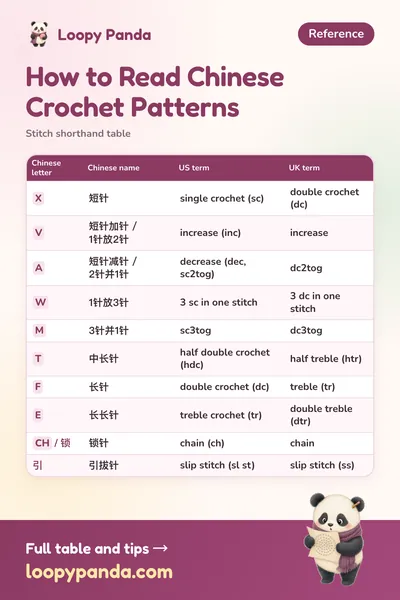
Stitch shorthand table
| Chinese letter | Chinese name | US term | UK term |
|---|---|---|---|
X | 短针 | single crochet (sc) | double crochet (dc) |
V | 短针加针 / 1针放2针 | increase (inc) | increase |
A | 短针减针 / 2针并1针 | decrease (dec, sc2tog) | dc2tog |
W | 1针放3针 | 3 sc in one stitch | 3 dc in one stitch |
M | 3针并1针 | sc3tog | dc3tog |
T | 中长针 | half double crochet (hdc) | half treble (htr) |
F | 长针 | double crochet (dc) | treble (tr) |
E | 长长针 | treble crochet (tr) | double treble (dtr) |
CH / 锁 | 锁针 | chain (ch) | chain |
引 / SL | 引拔针 | slip stitch (sl st) | slip stitch (ss) |
TV / FV | 中长针加针 / 长针加针 | 2 hdc in one stitch / 2 dc in one stitch | 2 htr / 2 tr in one stitch |
K6 / 空6针 / 跳6针 | 跳过6针 | skip 6 stitches | miss 6 stitches |
Common words in Chinese patterns
| Chinese | English |
|---|---|
| 环起 / 环形起针 | start with a magic ring |
| 起针 / 锁针起针 | foundation chain |
| 第…圈 / 第…行 | round … / row … |
| 不加不减 | no increases or decreases (1 sc in each stitch) |
| 后半针 / 条纹针 | back loop only (BLO) |
| 前半针 | front loop only (FLO) |
| 换色 | change colour |
| 塞棉 / 填充 | stuff with fiberfill |
| 收针 / 收口 | fasten off / close the opening |
| 留长线 | leave a long tail (for sewing) |
| 缝合 | sew together |
| 安全眼 / 眼距 | safety eyes / distance between eyes |
| 往返钩 / 片钩 | work flat, in rows (turn at the end of each row) |
| 圈钩 / 螺旋钩 | work in rounds / continuous spiral |
| 记号扣 | stitch marker |
| 钩针 2.0mm | 2.0 mm crochet hook |
| 翻转 | turn your work |
| 起立针 / 起立 | turning chain or starting chain (a CH at the start of a line); it does not count as a stitch |
| 与第1针引拔相连 | join with a slip stitch to the first stitch (joined round) |
| 倒二回钩 / 倒7回钩 | work into the 2nd / 7th chain from the hook |
| 带线 | join the yarn (attach it in the stitch named, then start) |
| 断线 / 不断线 | cut the yarn / don’t cut it, keep going |
| 钩两个,第一个断线,第二个不断线 | make two; fasten off the first, keep the second on the hook to join them (legs, ears) |
| 做标记 / 标记第10针 | place a stitch marker / mark stitch 10 |
| 扣眼 | buttonhole (usually a small chain loop) |
| 对折 | fold in half |
Worked example: a basic amigurumi ball
Here is a typical Chinese pattern for a ball, followed by the US translation.
| Chinese pattern | US translation | Stitches |
|---|---|---|
| 第1圈:环起6X | Rnd 1: 6 sc in magic ring | 6 |
| 第2圈:6V | Rnd 2: inc in each st | 12 |
| 第3圈:(1X,1V)×6 | Rnd 3: (sc 1, inc) ×6 | 18 |
| 第4圈:(2X,1V)×6 | Rnd 4: (sc 2, inc) ×6 | 24 |
| 第5-8圈:24X 不加不减 | Rnds 5–8: sc in each st | 24 |
| 第9圈:(2X,1A)×6 | Rnd 9: (sc 2, dec) ×6 | 18 |
| 第10圈:(1X,1A)×6 塞棉 | Rnd 10: (sc 1, dec) ×6, then stuff | 12 |
| 第11圈:6A 收口 | Rnd 11: dec ×6, fasten off and close | 6 |
Notice the pattern: each increase round adds 6 stitches and each decrease round removes 6. That is true of almost all round amigurumi, in any language.
Worked example: rows with chains and skipped stitches
Doll clothes and flat pieces are often worked in joined rounds or rows. Then every line starts with CH (the turning chain, not counted) and a joined round ends with SL. This made-up example leaves two armholes in a small top: skip 6 stitches for each sleeve and chain 2 across the gap.
| Chinese pattern | US translation | Stitches |
|---|---|---|
| R5:CH,翻转,4(6X,V),与第1针引拔相连(共28针) | Row 5: ch 1, turn, (sc 6, inc) ×4, join with a sl st to the first st | 28 |
| R6:CH,4X,2CH,K6,8X,2CH,K6,4X,SL(共20针) | Rnd 6: ch 1, sc 4, ch 2, skip 6 (armhole), sc 8, ch 2, skip 6 (armhole), sc 4, sl st to join | 20 |
| R7:CH,4X,在2CH处钩2X,8X,在2CH处钩2X,4X,SL(共20针) | Rnd 7: ch 1, sc 4, 2 sc in the ch-2 space, sc 8, 2 sc in the ch-2 space, sc 4, sl st to join | 20 |
Check it the same way as a round: in round 6 you use 4 + 6 + 8 + 6 + 4 = 28 stitches from round 5, and you make 4 + 2 + 8 + 2 + 4 = 20 (each chain counts as a stitch for the next round).
Tips for translating a whole pattern
- Translate one round at a time and write the US version next to it before you start crocheting.
- Always check the stitch count in brackets. If your count is different, re-read the round rather than guessing.
- Watch for stitch counts that don’t add up. Hand-made pattern images shared online often contain a round or two where the count in brackets doesn’t match the instructions; add up what the round uses and makes before you crochet it.
- Some designers use their own letters. Look for a key (符号说明) at the top of the pattern.
- Chinese yarn names are often brand or fibre names, such as 牛奶棉 (milk cotton, a cotton–acrylic blend). Match the hook size and finished size rather than the yarn name.
- If the pattern only has a symbol chart, use our crochet chart symbol table.
Chart symbols on this page
Frequently asked questions
What does X mean in a Chinese crochet pattern?
X is a single crochet (短针). It comes from the X-shaped chart symbol used in Chinese and Japanese charts. In UK terms it is a double crochet.
What do V and A mean?
V is an increase: 2 single crochet in the same stitch. A is a decrease: 2 stitches worked together. Their shapes match the chart symbols.
What does (2X,1V)×6 mean?
Repeat 6 times: 1 single crochet in each of the next 2 stitches, then 1 increase. It turns 18 stitches into 24.
What does 不加不减 mean?
“No increase, no decrease.” Work 1 single crochet in every stitch, so the stitch count stays the same.
Are Chinese and Japanese crochet patterns the same?
They use the same chart symbols. Chinese written patterns add the letter shorthand (X, V, A, T, F); Japanese patterns mostly rely on the chart and write stitch names in Japanese.
Can I use Google Translate on a Chinese crochet pattern?
It helps with the notes, but it often mistranslates the stitch letters and terms like 条纹针. Use the tables on this page for the stitches and translate only the notes by machine.
Save it for later
Pin this guide to your Pinterest board so it's there when you pick up your hook.
Save to Pinterest
Tell me when new free patterns are out
We'll send you a short email when a new free pattern or tutorial goes up. No spam.
Thank you! You're on the list. We'll email you when a new free pattern is out.
Please enter a valid email address.
Please tick the box to agree to receive our emails.
Too many tries. Please wait a few minutes and try again.
Something went wrong. Please try again later.
New short videos every week, too, on YouTube