 Loopy Panda
How to Make an Invisible Decrease

An invisible decrease turns 2 single crochet into 1 without leaving a bump or gap. Insert the hook into the front loop only of the next stitch, then the front loop only of the following stitch (3 loops on the hook). Yarn over and pull through 2 loops, then yarn over and pull through the last 2. It is the standard decrease for amigurumi.
What you need
- Yarn and a crochet hook (for amigurumi, usually one or two sizes smaller than the yarn label)
- Stitch marker
Step by step
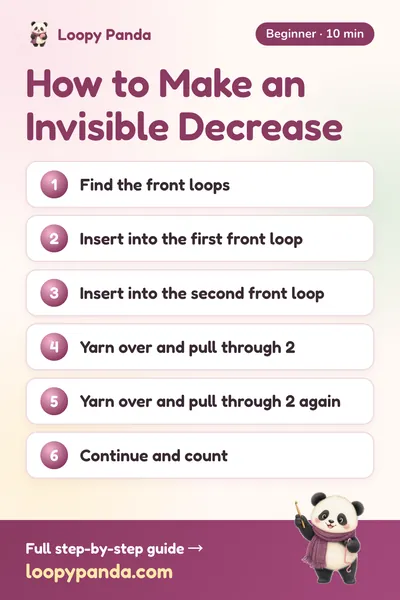
- Find the front loopsLook at the top of the next 2 stitches. Each has a V: the front loop is the strand closer to you, the back loop is the one farther away.
- Insert into the first front loopInsert the hook under the front loop only of the next stitch, from front to back. Do not yarn over.
- Insert into the second front loopWithout pulling anything through, insert the hook under the front loop only of the following stitch. You now have 3 loops on the hook.
- Yarn over and pull through 2Yarn over and pull through the 2 front loops. 2 loops remain on the hook.
- Yarn over and pull through 2 againYarn over and pull through both loops on the hook. One loop remains. That is one decrease: 2 stitches became 1.
- Continue and countWork the plain single crochet the pattern asks for until the next decrease. Each decrease removes 1 stitch, so 6 decreases turn 24 stitches into 18.
Invisible decrease vs standard decrease
| Invisible decrease | Standard sc2tog | |
|---|---|---|
| How | Front loops of 2 stitches, yo pull through 2, yo pull through 2 | Pull up a loop in each of 2 stitches (3 loops on hook), yo pull through all 3 |
| Look | Blends in like one normal stitch | Leaves a small bump and can open a gap |
| Best for | Amigurumi worked in rounds | Flat pieces, rows, or when the pattern asks for it |
| Stitch count | 2 stitches become 1 | 2 stitches become 1 |
How decreases appear in patterns
| Pattern style | What you will see | Meaning |
|---|---|---|
| US written | dec, sc2tog, or invdec | Decrease 2 stitches into 1 |
| UK written | dec or dc2tog | The same decrease; UK dc = US sc |
| Chinese written | A, 短针减针, 2针并1针 | One decrease; 6A = 6 decreases |
| Chart | An upside-down V (Λ) | See the decrease symbol |
Most patterns just say “dec” or A. Unless the pattern says otherwise, you can use the invisible decrease for any single crochet decrease in amigurumi.
Common mistakes
- Going under both loops. Picking up both loops of each stitch makes a bulkier decrease that shows. Use the front loops only.
- Pulling through all 3 loops at once. After picking up the 2 front loops, pull through 2 first, then 2. Pulling through all 3 at once makes a short, tight stitch instead of a single crochet.
- Holes around decreases. Pull each decrease snug. If holes remain, try a smaller hook. See fixing gaps in amigurumi.
- Decreasing in the same place every round. Like increases, stacked decreases make corners. Shift them by 1 or 2 stitches on alternate rounds, keeping the count the same.
Chart symbols on this page
Frequently asked questions
What does A mean in a Chinese crochet pattern?
A is 短针减针, also written 2针并1针: 2 stitches worked together into 1. 6A means 6 decreases.
What is a decrease called in UK crochet terms?
Usually “dec”, or dc2tog (double crochet 2 together), because UK double crochet is the US single crochet.
Can I use the invisible decrease when a pattern just says dec?
Yes, for single crochet amigurumi. It gives the same stitch count as a standard decrease; it only looks neater.
Why do I have a hole after my decrease?
The decrease was pulled loose, or you went through both loops. Use front loops only, pull the stitch snug, and check your hook size.
Does the invisible decrease work for rows?
It is designed for rounds, where the right side is always facing you. In rows the front loops alternate sides, so a standard sc2tog is often used there instead.
Save it for later
Pin this guide to your Pinterest board so it's there when you pick up your hook.
Save to Pinterest
Tell me when new free patterns are out
We'll send you a short email when a new free pattern or tutorial goes up. No spam.
Thank you! You're on the list. We'll email you when a new free pattern is out.
Please enter a valid email address.
Please tick the box to agree to receive our emails.
Too many tries. Please wait a few minutes and try again.
Something went wrong. Please try again later.
New short videos every week, too, on YouTube