 Loopy Panda
How to Count Crochet Stitches and Rows
Each V along the top edge of a row is one stitch; the loop on your hook never counts, and a turning chain counts only if the pattern says so. To count rows, follow one column of stitches straight up: every stitch in that column is one row. Single crochet rows are short and square; double crochet rows are tall posts.
How to count stitches in a row
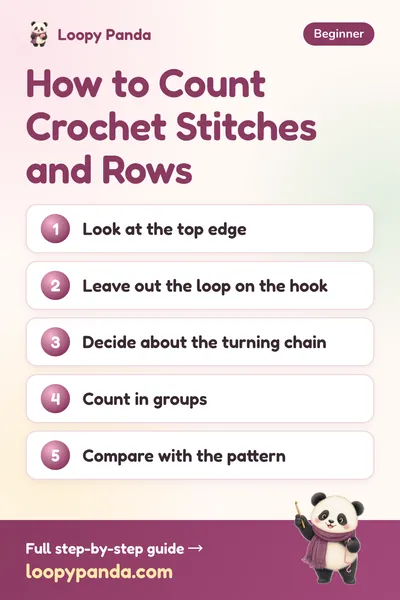
- Look at the top edgeHold the work with the last row on top. Each stitch has two loops at the top that form a sideways V (like a chain lying on the edge). One V is one stitch.
- Leave out the loop on the hookThe loop on your hook is not a stitch, even though it looks like one. Start counting from the V just below it.
- Decide about the turning chainIn single crochet the ch 1 at the start of the row usually does not count, so do not count it. In double crochet a ch 3 usually counts as the first stitch, so count it as one. Check your pattern notes.
- Count in groupsCount in fives or tens and slip a stitch marker into every 10th stitch. If you lose count, you only need to recount from the last marker.
- Compare with the patternPatterns often give the stitch count at the end of a row, for example “(24)”. If your count differs, find the missing or extra stitch now, before it spreads; see why crochet gets wider or narrower.
How to count a foundation chain
- Look at the front of the chain, where it forms a line of V's. Each V is one chain.
- Do not count the slip knot at the start, and do not count the loop on the hook.
- For long chains, put a marker in every 10th or 20th chain as you make it, so you do not have to count hundreds at the end.
- Chains are easier to count before you work into them. Count twice before starting row 1.
How to count rows
Every row adds one stitch on top of each stitch below it, so a straight column of stitches has as many stitches as there are rows. Pick a column away from the edges and count up it, using the tip of a tapestry needle to point.
| Stitch | What one row looks like | Counting tip |
|---|---|---|
| Single crochet (sc) | A short stitch, about as tall as it is wide | Count the stitches in one column; turn the work a little so the light shows each stitch |
| Half double crochet (hdc) | A medium stitch with an extra horizontal bar | Count the bars or the stitches in one column |
| Double crochet (dc) | A tall post with a slanted wrap in the middle | Count the posts stacked on top of each other |
| Treble crochet (tr) | A very tall post with two wraps | Count the posts; each one is a row |
Counting along the side edge also works: every row has one end on each side. Turning chains can make the edge hard to read, so a column in the middle is more reliable.
How to count rounds
For work in the round, count the rings of stitches from the centre out: the first ring around the magic ring is round 1. In a flat circle of single crochet that starts with 6 stitches, the stitch count also tells you the round: each increase round adds 6, so 24 stitches is round 4. For keeping track of rounds in amigurumi spirals, see stitch markers and counting rounds.
Tools that make counting easier
- Stitch markers in every 10th stitch and at the start of each row.
- A row counter (a small dial or a phone app): turn it at the end of each row.
- Pencil tally marks on the pattern, one per finished row.
- A contrast thread woven up the side every 10 rows, so you only count from the last one.
Chart symbols on this page
Frequently asked questions
Does the loop on the hook count as a stitch?
No. The loop on the hook is where the next stitch starts. Start counting from the stitch just below it.
Does the slip knot count as a chain?
No. Count only the V's formed after the slip knot, and do not count the loop on the hook.
How do I count rows in single crochet?
Follow one column of stitches straight up from the bottom and count each stitch; each one is a row.
Does the turning chain count as a stitch?
In most US patterns the ch 1 of single crochet does not count and the ch 3 of double crochet does. Always follow your pattern's notes.
How do I keep count on a very long foundation chain?
Put a stitch marker in every 10th or 20th chain as you go, then count the markers.
Save it for later
Pin this guide to your Pinterest board so it's there when you pick up your hook.
Save to Pinterest
Tell me when new free patterns are out
We'll send you a short email when a new free pattern or tutorial goes up. No spam.
Thank you! You're on the list. We'll email you when a new free pattern is out.
Please enter a valid email address.
Please tick the box to agree to receive our emails.
Too many tries. Please wait a few minutes and try again.
Something went wrong. Please try again later.
New short videos every week, too, on YouTube