 Loopy Panda
Yarn Weight Chart for Crochet
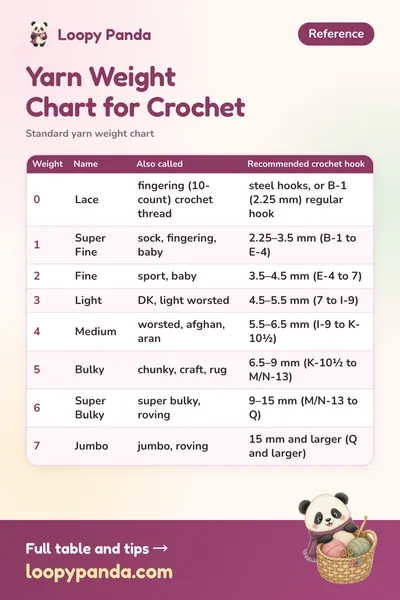
Yarn is grouped into eight standard weights from 0 (Lace) to 7 (Jumbo). The most common for crochet are 3 Light (DK), 4 Medium (worsted or aran) and 5 Bulky (chunky). Each weight has a recommended hook range, such as 5.5–6.5 mm for worsted. For amigurumi, use a smaller hook than the label suggests.
Standard yarn weight chart
This follows the Craft Yarn Council (CYC) yarn weight system. The number is often printed on the yarn label inside a small skein symbol.
| Weight | Name | Also called | UK name | Recommended crochet hook |
|---|---|---|---|---|
| 0 | Lace | fingering (10-count) crochet thread | lace | steel hooks, or B-1 (2.25 mm) regular hook |
| 1 | Super Fine | sock, fingering, baby | 4-ply | 2.25–3.5 mm (B-1 to E-4) |
| 2 | Fine | sport, baby | — | 3.5–4.5 mm (E-4 to 7) |
| 3 | Light | DK, light worsted | DK | 4.5–5.5 mm (7 to I-9) |
| 4 | Medium | worsted, afghan, aran | aran | 5.5–6.5 mm (I-9 to K-10½) |
| 5 | Bulky | chunky, craft, rug | chunky | 6.5–9 mm (K-10½ to M/N-13) |
| 6 | Super Bulky | super bulky, roving | super chunky | 9–15 mm (M/N-13 to Q) |
| 7 | Jumbo | jumbo, roving | — | 15 mm and larger (Q and larger) |
The hook ranges are what the yarn industry suggests for garments and blankets. The yarn label is the best guide for a specific yarn. For hook conversions, see the crochet hook size chart.
Yarn weight for amigurumi
Amigurumi can be made in any weight. The weight changes the finished size, not the pattern. The same pattern in DK comes out smaller than in worsted.
- Use a smaller hook than the label. Tight stitches keep stuffing from showing. Worsted is often worked with a 3.5–4 mm hook and DK with a 2.5–3.5 mm hook.
- Match the pattern's hook and yarn. If you change the weight, the toy changes size, and safety eyes may need to be a different size too.
- Chinese yarn names. Chinese patterns often name a yarn type instead of a weight, such as 牛奶棉 (milk cotton). Use the hook size in mm and the finished size to choose a substitute.
How to tell yarn weights apart
- Read the label. Look for the weight number (0–7) or a name like DK or worsted, plus the suggested hook or needle size.
- Compare length per weight. Two yarns with a similar length per 100 g (or per 50 g) are usually a similar weight. Fiber type changes this a little.
- Make a swatch. Crochet a small square with the hook you plan to use. This is the only sure way to know how the yarn behaves in your hands.
Frequently asked questions
Is DK yarn the same as worsted?
No. DK is weight 3 (Light) and worsted is weight 4 (Medium), so worsted is thicker. Some yarns labeled “light worsted” sit close to DK.
Is aran the same as worsted?
They are both weight 4 (Medium). Aran is usually a little thicker than worsted, but many patterns treat them as interchangeable.
What does 4-ply mean in the UK?
In UK patterns, 4-ply is a thin yarn close to US fingering weight (weight 1, Super Fine). It does not mean the yarn has four strands.
What weight is milk cotton yarn?
It varies by brand. Milk cotton (牛奶棉) is a fibre name, not a weight. Check the label for the suggested hook size in mm, and compare the length per 50 g with the yarn in your pattern.
What yarn weight is best for beginners?
Medium (4, worsted) or Light (3, DK) in a smooth, light-coloured yarn. It is easy to see each stitch, which helps when counting.
Save it for later
Pin this guide to your Pinterest board so it's there when you pick up your hook.
Save to Pinterest
Tell me when new free patterns are out
We'll send you a short email when a new free pattern or tutorial goes up. No spam.
Thank you! You're on the list. We'll email you when a new free pattern is out.
Please enter a valid email address.
Please tick the box to agree to receive our emails.
Too many tries. Please wait a few minutes and try again.
Something went wrong. Please try again later.
New short videos every week, too, on YouTube