 Loopy Panda
How to Crochet a Flat Circle
To crochet a flat circle in single crochet, work 6 sc into a magic ring, then add 6 stitches every round: increase in every stitch on round 2, then (sc 1, inc) ×6, (sc 2, inc) ×6, and so on. Round n has 6 × n stitches. Taller stitches need more: 12 per round for double crochet.
What you need
- Worsted weight (4, Medium) yarn
- Crochet hook that suits your yarn, such as 5 mm (H-8) for worsted
- Stitch marker
Single crochet circle, round by round
- Round 1: 6 scMake a magic ring and work 6 single crochet into it. Pull the tail to close. (6)
- Round 2: increase in every stitchWork 2 sc into each stitch, which is 6 increases. (12)
- Round 3: (sc 1, inc) ×6*1 sc in the next stitch, 2 sc in the next stitch*; repeat 6 times. (18)
- Round 4: (sc 2, inc) ×6*1 sc in each of the next 2 stitches, 2 sc in the next*; repeat 6 times. (24)
- Keep adding one plain stitch per repeatRound 5 is
(sc 3, inc) ×6(30), round 6 is(sc 4, inc) ×6(36), and so on. In general, round n is(sc n−2, inc) ×6and ends with 6 × n stitches. - Choose spiral or joined roundsYou can work in a continuous spiral, moving a stitch marker up each round, or join each round with a slip stitch and
ch 1(the ch 1 does not count). Joined rounds leave a faint seam line; a spiral leaves a small step at the end, which you can smooth with a slip stitch into the next stitch before fastening off. - Stop and finishWhen the circle is the size you want, stop increasing and fasten off. Count your stitches at the end of every round; the count is the fastest way to catch a mistake.
Circle formulas for sc, hdc and dc
Taller stitches spread out further each round, so they need more stitches per round to stay flat. These are the usual starting numbers; your tension and yarn can change them slightly.
| Stitch | Round 1 | Add each round | Round 2 | Round 3 | Round 4 |
|---|---|---|---|---|---|
| Single crochet (sc) | 6 sc in ring | 6 | inc in each st (12) | (sc 1, inc) ×6 (18) | (sc 2, inc) ×6 (24) |
| Half double crochet (hdc) | 8 hdc in ring (some patterns use 10 or 12) | same number as round 1 | inc in each st (16) | (hdc 1, inc) ×8 (24) | (hdc 2, inc) ×8 (32) |
| Double crochet (dc) | ch 3 (counts as dc), 11 dc in ring = 12 | 12 | 2 dc in each st (24) | (dc 1, 2 dc in next) ×12 (36) | (dc 2, 2 dc in next) ×12 (48) |
For hdc and dc circles, join each round with a slip stitch to the top of the first stitch and start the next round with the turning chain, because tall stitches in a spiral leave a very visible step. If the pattern's ch 3 counts as a dc, remember to count it.
How to stop your circle turning into a hexagon
If every increase sits exactly above the increase in the round below, the 6 increase lines build up into 6 corners and the circle becomes a hexagon. This is fine for amigurumi but not for coasters or rugs.
- Split the plain stitches. On every other round, put half of the plain stitches before the increase and half after. For example, round 4 becomes
(sc 1, inc, sc 1) ×6(24) instead of(sc 2, inc) ×6, and round 6 becomes(sc 2, inc, sc 2) ×6(36). - Start the round in a different place. Beginning each round a stitch or two later also moves the increases around.
- The stitch count stays exactly the same; only the position of the increases changes.
Troubleshooting: cupping, ruffling and waves
| What you see | Likely cause | Fix |
|---|---|---|
| Edges curl up like a bowl (cupping, 起碗) | Too few stitches for the round, or very tight tension | Count stitches; add missing increases. If counts are right, go up a hook size or loosen your tension. |
| Edges ripple like a wave (ruffling, 起波浪) | Too many stitches: extra increases, or working into a joining slip stitch or chain as if it were a stitch | Count stitches; undo to the last correct round. If counts are right, try a smaller hook. |
| Pointy corners | Increases stacked in the same place every round | Stagger the increases as shown above. |
| Flat in the middle, cups at the edge only | Tension getting tighter as you go | Relax your yarn hand, or change to a slightly bigger hook for the outer rounds. |
Curling on flat pieces worked in rows is a different problem; see why is my crochet curling.
Chart symbols on this page
Frequently asked questions
Why do you add 6 stitches per round in a single crochet circle?
Each round is roughly one single crochet taller, so the outer edge gets longer by about the same amount every round. Six extra stitches per round is the number that keeps a sc circle close to flat for most people.
How many stitches do I start with for a double crochet circle?
Usually 12: chain 3 (which counts as the first dc) and 11 more dc into the ring. Then add 12 stitches every round.
Why is my crochet circle not flat?
If it cups like a bowl, it has too few stitches or your tension is tight. If it ruffles, it has too many. Count each round first, then adjust hook size if the counts are right.
Is a flat circle the same as the start of an amigurumi ball?
Yes. Amigurumi balls and heads start with exactly this 6-per-round circle. When you stop increasing, the sides begin to curve up into a sphere.
Do I have to use a magic ring?
No. You can chain 2 and work the first round into the second chain from the hook, or chain 4 and join into a ring. The magic ring just closes the centre hole.
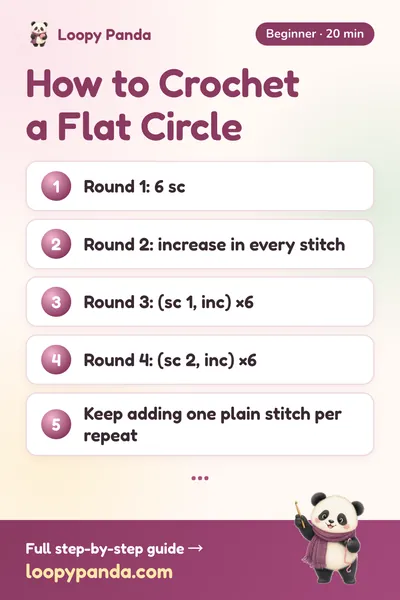
Save it for later
Pin this guide to your Pinterest board so it's there when you pick up your hook.
Save to Pinterest
Tell me when new free patterns are out
We'll send you a short email when a new free pattern or tutorial goes up. No spam.
Thank you! You're on the list. We'll email you when a new free pattern is out.
Please enter a valid email address.
Please tick the box to agree to receive our emails.
Too many tries. Please wait a few minutes and try again.
Something went wrong. Please try again later.
New short videos every week, too, on YouTube