 Loopy Panda
How to Crochet a Granny Square

A classic granny square is made of 3-double-crochet clusters worked in joined rounds from a small ring. Each corner is (3 dc, ch 2, 3 dc) in the same space, and a chain 1 separates the clusters along the sides. Round 1 has 4 clusters, and every round after that adds one cluster per side.
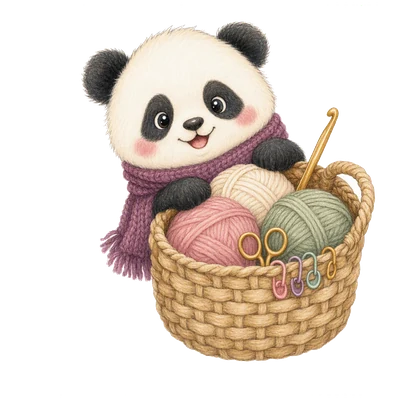
What you need
- Worsted weight (4, Medium) yarn in 1–4 colours; a smooth, light colour is easiest to learn with
- 5 mm (H-8) crochet hook, or the size on your yarn label
- Scissors
- Tapestry (yarn) needle for weaving in ends and joining
Round by round
- Know the convention used hereThis page uses US terms. Corners are
(3 dc, ch 2, 3 dc)worked into one chain-2 space. Side spaces are a singlech 1between clusters. Thech 3at the start of each round counts as the first double crochet. Every round is joined with a slip stitch, and you do not turn the work. - Make the centre ringMake a magic ring, or
ch 4and join with a slip stitch to the first chain to form a ring. The magic ring closes fully; the chain-4 ring leaves a small hole in the centre. - Round 1: 4 clusters
Ch 3(counts as 1 dc), work 2 dc into the ring,ch 2. *Work 3 dc into the ring,ch 2*; repeat from * 2 more times. Join with a slip stitch to the top of the beginning ch 3. You have 4 clusters (12 dc) and 4 ch-2 corner spaces. If you used a magic ring, pull the tail to close it now. - Round 2: 8 clustersSlip stitch into the next 2 dc and into the ch-2 corner space.
Ch 3, then(2 dc, ch 2, 3 dc)in the same corner space. *Ch 1,(3 dc, ch 2, 3 dc)in the next corner space*; repeat from * 2 more times.Ch 1and join to the top of the ch 3. You have 8 clusters (24 dc), 4 corners and 1 ch-1 space on each side. - Round 3: 12 clustersSlip stitch into the next 2 dc and into the corner space.
Ch 3,(2 dc, ch 2, 3 dc)in the same space. *Ch 1, 3 dc in the next ch-1 space,ch 1,(3 dc, ch 2, 3 dc)in the next corner space*; repeat from * 2 more times.Ch 1, 3 dc in the last ch-1 space,ch 1, join. You have 12 clusters (36 dc) and 2 ch-1 spaces on each side. - Round 4: 16 clustersSlip stitch into the next 2 dc and into the corner space.
Ch 3,(2 dc, ch 2, 3 dc)in the same space. *[Ch 1, 3 dc in the next ch-1 space] twice,ch 1,(3 dc, ch 2, 3 dc)in the next corner space*; repeat from * 2 more times. [Ch 1, 3 dc in the next ch-1 space] twice,ch 1, join. You have 16 clusters (48 dc) and 3 ch-1 spaces on each side. - Keep going or finishFor bigger squares, repeat round 4, working one more side cluster on each side every round. To finish, cut the yarn, pull it through the loop on your hook, and weave in the ends.
Stitch count check
Count clusters, not single stitches. Each round has 4 corners, and the number of clusters goes up by 4 every round.
| Round | Clusters | Double crochet | Ch-1 spaces per side |
|---|---|---|---|
| 1 | 4 | 12 | 0 (ch-2 between clusters becomes the corners) |
| 2 | 8 | 24 | 1 |
| 3 | 12 | 36 | 2 |
| 4 | 16 | 48 | 3 |
| Any round n | 4 × n | 12 × n | n − 1 |
Chinese patterns usually call this square 祖母方块 or 奶奶格. In UK terms every “dc” on this page is a “tr” (treble); see US vs UK crochet terms.
Changing colour between rounds
The simplest way is to change colour at the start of a round, in a corner.
- Finish the round and join as usual. Cut the old colour, leaving a 10–15 cm (4–6 in) tail, and pull it through the loop to fasten off.
- Make a slip knot in the new colour and put it on your hook.
- Insert the hook into any ch-2 corner space, yarn over with the new colour, and pull up a loop.
Ch 3and carry on with the next round from “(2 dc, ch 2, 3 dc) in the same space”. You do not need the slip stitches to move into the corner. - Hold both tails along the top of the round and work the next few clusters over them. This hides some of the tail and makes weaving in quicker.
How to join granny squares
Block or at least flatten all squares to the same size first. Place two squares together and match the corners.
- Whip stitch (sewn). Put the squares right sides together and sew through the matching stitches with a tapestry needle. Sewing through the back loops only gives a flatter seam. It is the easiest join to keep neat.
- Slip stitch join. With the squares right sides together, slip stitch through both edges from corner to corner. It makes a firm, fairly flat seam on the wrong side.
- Single crochet join. Put the squares wrong sides together and single crochet through both edges. This leaves a raised ridge on the front, which many people use as a decorative outline.
- Join as you go. Instead of sewing, you connect the last round of a new square to a finished square while you crochet it, usually with a slip stitch into the neighbouring chain spaces. It saves sewing but takes some practice to keep the corners tidy.
Common problems
- The square is twisting or slanting. Worked without turning, rounds can drift slightly. Check that each round starts in a corner. Some crocheters turn the work at the end of every round to reduce the drift; either way works if you do the same on every round.
- Corners are rounded or the square cups. Check that every corner has the ch 2. A missing corner chain pulls the square in.
- The square ruffles or waves. You probably have an extra cluster on a side. Count the ch-1 spaces per side with the table above.
- A gap at the join. Make sure you join to the top of the ch 3, not to the first ch-1 space.
Chart symbols on this page
Frequently asked questions
How do I crochet one granny square, step by step?
Make a ring (a magic ring or ch 4 joined with a slip stitch). Round 1: ch 3 (counts as a dc), 2 dc into the ring, ch 2, then (3 dc, ch 2) three times and join: 4 clusters. Round 2: slip stitch into the corner space and work (3 dc, ch 2, 3 dc) in each corner space with ch 1 between corners: 8 clusters. From round 3, add one 3-dc cluster in each side space too. Four rounds make a small square; fasten off and weave in the ends.
Does the chain 3 count as a double crochet?
In this pattern, yes. The ch 3 at the start of each round counts as the first dc of the first cluster, so you only work 2 more dc to complete it.
Why are the corners ch 2 and the sides ch 1?
The corners need extra room to turn 90 degrees and lie flat. Along the sides the fabric only needs a small gap, so a single chain is enough. Some patterns use ch 1, ch 2 or no chains at all; follow your pattern and stay consistent.
Should I start with a magic ring or a chain 4 ring?
Either works. A magic ring closes completely. A ch-4 ring is easier for beginners and leaves a small open hole in the centre, which is part of the classic look.
How many rounds is a granny square?
There is no fixed number. A square can have 3 rounds for a coaster or keep growing into a whole blanket. Follow the size your pattern asks for.
What is the best yarn for granny squares?
A smooth worsted (4, Medium) or DK (3, Light) yarn is easiest because the clusters and spaces are easy to see. Use the same yarn weight for all squares that will be joined, so they come out the same size.
What is 祖母方块 or 奶奶格?
Both are Chinese names for the granny square. Chinese patterns also write the double crochet as F (长针).
Save it for later
Pin this guide to your Pinterest board so it's there when you pick up your hook.
Save to Pinterest
Tell me when new free patterns are out
We'll send you a short email when a new free pattern or tutorial goes up. No spam.
Thank you! You're on the list. We'll email you when a new free pattern is out.
Please enter a valid email address.
Please tick the box to agree to receive our emails.
Too many tries. Please wait a few minutes and try again.
Something went wrong. Please try again later.
New short videos every week, too, on YouTube