 Loopy Panda
How to Decrease and Increase in Crochet: sc2tog, hdc2tog, dc2tog, tr2tog
To decrease with a crochet stitch, work it into two stitches but stop each one before its last step, then join them at the top. For dc2tog: yarn over, insert into the next stitch, pull up a loop, yarn over and pull through 2, so 2 loops remain; do the same in the following stitch, so 3 loops remain; then yarn over and pull through all 3. sc2tog, hdc2tog and tr2tog work the same way. Each one turns 2 stitches into 1. To increase, work 2 stitches into the same stitch.
What you need
- Medium (worsted) yarn in a light colour
- Crochet hook in the size on the yarn label, usually 5.0 mm (H-8) for worsted
- A small swatch of a few rows to practise on
Step by step
- Start the first double crochetYarn over, insert the hook into the next stitch, yarn over and pull up a loop. You have 3 loops on the hook.
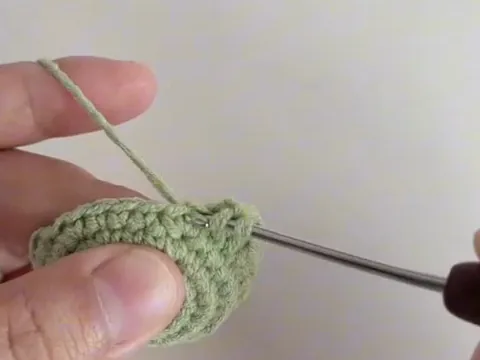
- Stop before the endYarn over and pull through 2 loops. Stop here: 2 loops remain. This is an unfinished double crochet.
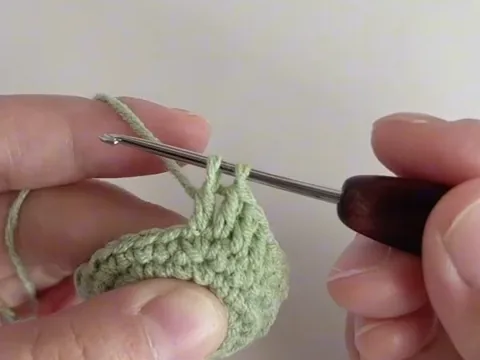
- Start the second double crochetYarn over, insert the hook into the following stitch, yarn over and pull up a loop. You have 4 loops on the hook.
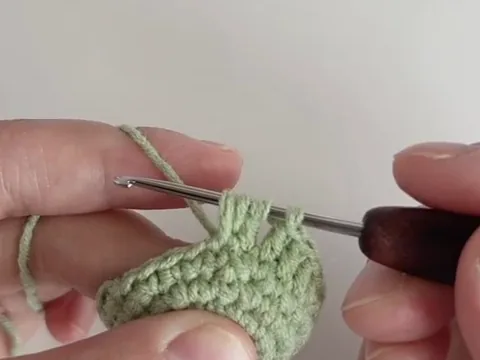
- Stop againYarn over and pull through 2 loops. 3 loops remain on the hook.
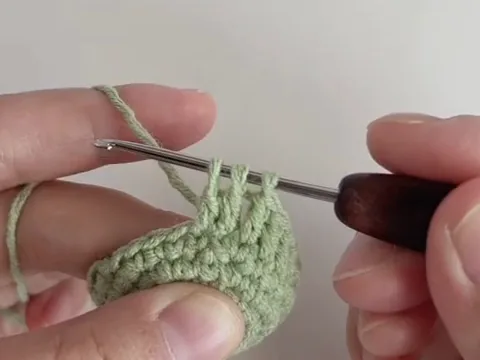
- Join themYarn over and pull through all 3 loops. One loop remains. Two stitches have become one: that is a dc2tog.
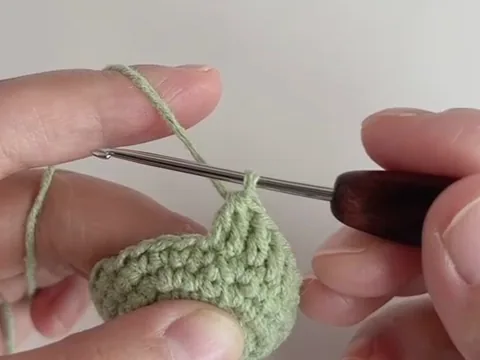
The four decreases side by side
Every decrease follows one rule: work each stitch until only its last step is left, keep those loops on the hook, and finish all the stitches together with one final pull-through. The tables below show where each stitch stops.
| Decrease (US) | UK name | Chinese | Each stitch stops after | Loops before the final pull-through |
|---|---|---|---|---|
sc2tog | dc2tog | 短针减针 A | Pulling up a loop | 3 |
hdc2tog | htr2tog | 中长针2针并1针 | Pulling up a loop | 5 |
dc2tog | tr2tog | 长针2针并1针 | The first pull through 2 | 3 |
tr2tog | dtr2tog | 长长针2针并1针 | The second pull through 2 | 3 |
Some Chinese patterns shorten these to the stitch letter plus A, the decrease mark: TA for a half double crochet decrease, FA for double crochet and EA for treble crochet. Check the pattern's key, because not every designer writes them this way.
How to sc2tog (single crochet 2 together)
Insert the hook into the next stitch, yarn over and pull up a loop: 2 loops on the hook. Insert into the following stitch, yarn over and pull up a loop: 3 loops. Yarn over and pull through all 3.
In amigurumi, the invisible decrease is usually neater: you go through the front loops of both stitches instead, so the decrease leaves no bump or gap.
How to hdc2tog (half double crochet 2 together)
Yarn over, insert the hook into the next stitch, yarn over and pull up a loop: 3 loops on the hook. Yarn over, insert into the following stitch, yarn over and pull up a loop: 5 loops. Yarn over and pull through all 5.
Pulling through 5 loops is the hardest part. Keep the loops loose and on the wide part of the hook, and pull each loop up to the same height before the final yarn over.
How to dc2tog (double crochet 2 together)
The steps at the top of this page are the dc2tog. In short: [yarn over, insert into the next stitch, pull up a loop, yarn over and pull through 2] twice, so 3 loops remain, then yarn over and pull through all 3. The finished decrease looks like an upside-down V: two legs, one top.
How to tr2tog (treble crochet 2 together)
Yarn over twice, insert the hook into the next stitch, yarn over and pull up a loop: 4 loops. Yarn over and pull through 2, twice: 2 loops remain. Yarn over twice, insert into the following stitch, pull up a loop: 5 loops. Yarn over and pull through 2, twice: 3 loops remain. Yarn over and pull through all 3.
How to increase in half double crochet
Work 2 half double crochet into the same stitch: one complete hdc, then yarn over and insert the hook into that same stitch again for the second. One stitch becomes two. Some Chinese patterns write this as TV, the half double crochet letter T plus V, the increase mark.
How to increase in double crochet
Work 2 double crochet into the same stitch. The two stitches share one base and open into a V at the top. Some Chinese patterns write this as FV. For single crochet, see the single crochet increase.
Common mistakes
- Finishing the first stitch completely. Then you have made two normal stitches, not a decrease. Stop each one before its last step.
- Working both halves into the same stitch. That makes a cluster or bobble, which does not reduce the count. A decrease always spans two stitches.
- Counting the decrease as two. A dc2tog, or any 2tog, counts as one stitch in the next row.
- Mixing up US and UK names. A UK tr2tog is a US dc2tog, and a UK dc2tog is a US sc2tog.
Single Crochet Decrease Symbol
A single crochet decrease joins 2 stitches into 1. Charts draw it as an upside-down V (Λ). Chinese patterns call it 短针减针 or 2针并1针 and write it as the letter “A”, so “6A” means 6 decreases. In amigurumi the invisible decrease is usually used.
| US name and abbreviation | Single Crochet Decrease (dec / sc2tog) |
|---|---|
| UK name and abbreviation | Decrease (dc2tog) (dc2tog) |
| Chinese name | 短针减针 (2针并1针、并针) |
| Chinese written shorthand | A |
| Japanese name | 細編み2目一度 |
What does “A” mean in a Chinese amigurumi pattern?
A is a decrease (2 stitches together). It looks like the chart symbol Λ.
Should I use a regular or invisible decrease?
For amigurumi, the invisible decrease (front loops only) leaves a smaller bump and fewer gaps. Use it unless the pattern says otherwise.
3 Single Crochet in One Stitch Symbol
Working 3 single crochet into one stitch adds 2 stitches at once and is used for sharp corners and oval starts. Charts show three stitches fanning out from one base. Chinese patterns write it as “W” (1针放3针).
| US name and abbreviation | 3 Single Crochet in One Stitch (3 sc in same st) |
|---|---|
| UK name and abbreviation | 3 dc in same st |
| Chinese name | 1针放3针 (短针3针加) |
| Chinese written shorthand | W |
| Japanese name | 細編み3目編み入れる |
Where is “W” used in amigurumi?
Mostly at the ends of an oval worked around a foundation chain, such as a foot or a snout, to turn the corner.
Single Crochet 3 Together Symbol
Single crochet 3 together (sc3tog) turns 3 stitches into 1, removing 2 stitches at once. Charts show three stitch legs meeting at one top point. Chinese patterns write it as “M” (3针并1针).
| US name and abbreviation | Single Crochet 3 Together (sc3tog) |
|---|---|
| UK name and abbreviation | dc3tog (dc3tog) |
| Chinese name | 3针并1针 |
| Chinese written shorthand | M |
| Japanese name | 細編み3目一度 |
How do I work sc3tog?
Insert the hook in the next stitch and pull up a loop, repeat in the next 2 stitches (4 loops on hook), then yarn over and pull through all 4 loops.
Chart symbols on this page
Frequently asked questions
What mistakes do beginners make with crochet decreases, and how do I avoid them?
The most common are finishing the first stitch completely (stop each one before its last step), working both halves into the same stitch (that makes a bobble, not a decrease; a decrease always spans two stitches) and counting the decrease as two stitches (it counts as one). In amigurumi, a standard decrease can leave a small gap; use an invisible decrease instead. Count your stitches at the end of every decrease round.
Does a dc2tog count as one stitch?
Yes. Any 2tog decrease turns 2 stitches into 1, and you work into its single top in the next row.
What is the difference between dc2tog and a bobble?
A dc2tog spreads its two unfinished stitches over two neighbouring stitches and removes one stitch. A bobble puts several unfinished stitches into the same stitch, so the count does not change.
What is dc2tog in UK terms?
tr2tog. UK names are one step higher: the UK treble is the US double crochet.
How many loops do you pull through in hdc2tog?
Five: the loop you started with plus two for each of the two half double crochets.
Tell me when new free patterns are out
We'll send you a short email when a new free pattern or tutorial goes up. No spam.
Thank you! You're on the list. We'll email you when a new free pattern is out.
Please enter a valid email address.
Please tick the box to agree to receive our emails.
Too many tries. Please wait a few minutes and try again.
Something went wrong. Please try again later.
New short videos every week, too, on YouTube