 Loopy Panda
How to Read Japanese Crochet Patterns (編み図)
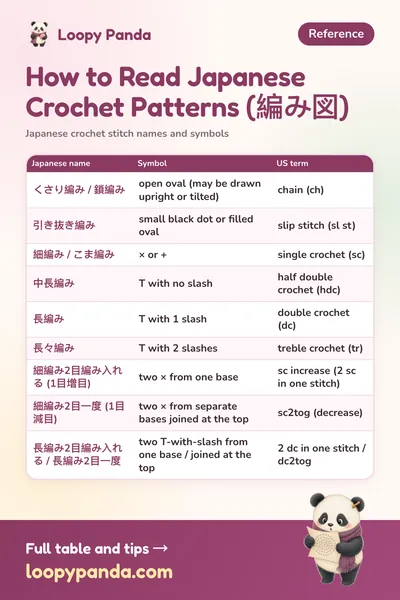
A Japanese crochet pattern is mostly a chart (編み図, amizu) plus a stitch-count table. Learn six symbols: oval = chain, black dot = slip stitch, × or + = single crochet (細編み), T = half double, T with one slash = double, two slashes = treble. Read rows from the bottom, alternating direction; read rounds from the center counterclockwise.
How to read a Japanese pattern, step by step
- Check yarn, hook and strandsThe top of the pattern lists the yarn, the hook (for example 4/0号, see Japanese hook sizes) and how many strands you hold: 1本どり means one strand, 2本どり means two strands together. ゲージ is the gauge, given as stitches and rows in a 10 cm square.
- Find the start on the chartFlat pieces start at the bottom on the foundation chain (作り目). Round pieces start in the center at わ, the yarn ring. An arrow marks where each row or round begins and which way it goes.
- Read the symbols one by oneEach symbol is one stitch. Use the stitch table below. A symbol drawn bigger, smaller or tilted is still the same stitch; the chart only bends it to fit the shape.
- Follow the row or round numberThe number at the edge of a flat chart (or on the ring for rounds) is the row or round, 段. Work that row in the direction of its arrow, then move up or out to the next one.
- Check the stitch count in the tableMost patterns also have a 目数表 with the columns 段 (round), 目数 (stitch count) and 増減 (increase or decrease). Count your stitches against it at the end of every round.
Japanese crochet stitch names and symbols
Japanese charts draw each stitch as a symbol whose height matches the stitch: single crochet is 1, half double 2, double 3. The slashes across a T show how many times you wrap the yarn before inserting the hook, so each extra slash makes the next taller stitch. Japanese single crochet (細編み or こま編み, both read koma-ami) is the US single crochet, which is called double crochet in UK patterns.
| Japanese name | Reading (romaji) | Symbol | US term | UK term |
|---|---|---|---|---|
| くさり編み / 鎖編み | kusari-ami | open oval (may be drawn upright or tilted) | chain (ch) | chain (ch) |
| 引き抜き編み | hikinuki-ami | small black dot or filled oval | slip stitch (sl st) | slip stitch (ss) |
| 細編み / こま編み | koma-ami | × or + | single crochet (sc) | double crochet (dc) |
| 中長編み | chūnaga-ami | T with no slash | half double crochet (hdc) | half treble (htr) |
| 長編み | naga-ami | T with 1 slash | double crochet (dc) | treble (tr) |
| 長々編み | naganaga-ami | T with 2 slashes | treble crochet (tr) | double treble (dtr) |
| 細編み2目編み入れる (1目増目) | koma-ami ni-me amiireru | two × from one base | sc increase (2 sc in one stitch) | 2 dc in one stitch |
| 細編み2目一度 (1目減目) | koma-ami ni-me ichido | two × from separate bases joined at the top | sc2tog (decrease) | dc2tog |
| 長編み2目編み入れる / 長編み2目一度 | naga-ami ni-me amiireru / ichido | two T-with-slash from one base / joined at the top | 2 dc in one stitch / dc2tog | 2 tr in one stitch / tr2tog |
S
i
n
g
l
e
c
r
o
c
h
e
t
c
a
n
a
p
p
e
a
r
a
s
×
i
n
o
n
e
b
o
o
k
a
n
d
+
i
n
a
n
o
t
h
e
r
;
b
o
t
h
m
e
a
n
t
h
e
s
a
m
e
s
t
i
t
c
h
,
s
o
a
l
w
a
y
s
c
h
e
c
k
t
h
e
k
e
y
(
記
号
)
p
r
i
n
t
e
d
w
i
t
h
t
h
e
c
h
a
r
t
.
増
目
m
e
a
n
s
“
s
t
i
t
c
h
i
n
c
r
e
a
s
e
d
”
a
n
d
減
目
“
s
t
i
t
c
h
d
e
c
r
e
a
s
e
d
”
,
s
o
1
目
増
目
i
s
a
o
n
e
-
s
t
i
t
c
h
i
n
c
r
e
a
s
e
.
Where the hook goes: joined or separate bases
Look at the bottom of tall symbols. If several symbols grow from one base, they are all worked into the same stitch, which is an increase. If symbols start from separate bases and meet at the top, they are finished together into one stitch, which is a decrease.
The same rule tells you how to work into a chain loop. When the bases of a group of tall symbols are closed together into one point, insert the hook into the stitch itself (割って編む, “split the stitch”). When the bases are drawn apart over a chain loop, work around the whole loop instead (束にすくう, “pick up as a bundle”).
Common Japanese pattern words
| Japanese | Reading | Meaning |
|---|---|---|
| 編み図 | amizu | the crochet chart (the main part of the pattern) |
| 目 | me | stitch; 目数 is the stitch count |
| 段 | dan | row or round; Japanese uses the same word for both, e.g. 3段め = row/round 3 |
| 作り目 | tsukurime | foundation chain or starting ring. The slip knot on the hook is not counted |
| わ / 輪の作り目 | wa / wa no tsukurime | start in a ring: a magic ring made from the yarn end, or chains joined into a ring. わの中に細編み6目編み入れる = work 6 sc into the ring |
| 立ち上がり | tachiagari | standing / turning chain at the start of each row or round (see below) |
| 往復編み | ōfuku-ami | worked in rows, turning the work at the end of every row |
| 輪編み | wa-ami | worked in rounds without turning |
| 増し目 / 減らし目 | mashime / herashime | increase / decrease |
| 毎段6目増 / 6目減 | maidan roku-me zō / gen | increase 6 stitches every round / decrease 6 stitches |
| 増減なし | zōgen nashi | no increase or decrease: one stitch in each stitch |
| 編み入れる | amiireru | work (several stitches) into one stitch |
| 2目一度 | ni-me ichido | two stitches together (also written 2目1度) |
| すじ編み | suji-ami | single crochet in the back loop only, in rounds (see back loop only) |
| 裏山 | urayama | the back bump of a chain |
| 1本どり / 2本どり | ippon-dori / nihon-dori | hold 1 strand / 2 strands of yarn together |
| ゲージ | gēji | gauge, e.g. 細編み 26目24.5段が10cm角 = 26 sc and 24.5 rows in a 10 cm square |
| わた | wata | stuffing |
| とじ合わせる / とじつける | tojiawaseru / tojitsukeru | sew pieces together / sew one piece on |
| 糸をつける / 糸を切る | ito o tsukeru / ito o kiru | join the yarn / cut the yarn (fasten off) |
| 糸始末 | itoshimatsu | weave in the ends |
| 号 | gō | hook size number, e.g. 4/0号; see Japanese hook sizes in mm |
立ち上がり: does the turning chain count?
Each row or round starts with a few chains that bring the yarn up to the height of the stitches in that row. Japanese patterns call this 立ち上がり (tachiagari).
| Stitch in the row | 立ち上がり chains | Counts as a stitch? |
|---|---|---|
| 細編み (sc) | 1 | No |
| 中長編み (hdc) | 2 | Usually yes |
| 長編み (dc) | 3 | Usually yes |
| 長々編み (tr) | 4 | Usually yes |
C
l
o
v
e
r
’
s
b
a
s
i
c
s
s
h
e
e
t
g
i
v
e
s
t
h
e
r
u
l
e
:
f
o
r
h
a
l
f
d
o
u
b
l
e
a
n
d
t
a
l
l
e
r
,
t
h
e
s
t
a
n
d
i
n
g
c
h
a
i
n
c
o
u
n
t
s
a
s
o
n
e
s
t
i
t
c
h
;
f
o
r
s
i
n
g
l
e
c
r
o
c
h
e
t
i
t
i
s
s
o
s
h
o
r
t
t
h
a
t
i
t
d
o
e
s
n
o
t
c
o
u
n
t
.
S
o
m
e
p
a
t
t
e
r
n
s
a
d
d
a
n
o
t
e
s
u
c
h
a
s
立
ち
上
が
り
は
数
え
な
い
(
t
h
e
s
t
a
n
d
i
n
g
c
h
a
i
n
i
s
n
o
t
c
o
u
n
t
e
d
)
,
s
o
f
o
l
l
o
w
t
h
e
n
o
t
e
w
h
e
n
t
h
e
r
e
i
s
o
n
e
.
W
h
e
n
a
r
o
u
n
d
o
f
s
i
n
g
l
e
c
r
o
c
h
e
t
i
s
j
o
i
n
e
d
,
t
h
e
s
l
i
p
s
t
i
t
c
h
g
o
e
s
i
n
t
o
t
h
e
f
i
r
s
t
s
i
n
g
l
e
c
r
o
c
h
e
t
,
n
o
t
i
n
t
o
t
h
e
s
t
a
n
d
i
n
g
c
h
a
i
n
.
Which way to read a Japanese chart
Charts are drawn from the right side. Everything you see is how the front of the work looks, and arrows mark where each row or round starts and which way it goes.
Rows (往復編み): start at the bottom and work up. Row 1 is read right to left. You turn the work, so row 2 is read left to right, row 3 right to left again, in a zigzag. The row number sits at the side of the chart; some books put it on the right and others on the left, so follow the number and arrow.
Rounds (輪編み): start in the center at わ and read outward, one ring per round, counterclockwise (左回り, “turning left”) as seen from the right side. You never turn, so every round goes the same way.
These directions are for right-handed crocheters; Japanese charts are drawn for right-handed work. If you crochet left-handed, work the chart as a mirror image, so rounds go clockwise.
How to read a 目数・増減表 (stitch count table)
Many Japanese amigurumi patterns print a table next to each chart with the columns 段 (round), 目数 (stitches at the end of the round) and 増減 (how many to increase or decrease). A note like 毎段6目増 written beside several rows applies to every round in that bracket. Here is how the start of a body piece in a Hamanaka-designed rabbit pattern reads:
| 段 | 目数 | 増減 | In English |
|---|---|---|---|
| 1 | 6目 | わの中に細編み6目編み入れる | Rnd 1: 6 sc in a magic ring (6) |
| 2 | 12目 | 毎段6目増 | Rnd 2: inc in each st (12) |
| 3 | 18目 | 毎段6目増 | Rnd 3: (sc 1, inc) ×6 (18) |
| 4 | 24目 | 毎段6目増 | Rnd 4: (sc 2, inc) ×6 (24) |
| 5 | 30目 | 毎段6目増 | Rnd 5: (sc 3, inc) ×6 (30) |
| 6 | 36目 | 毎段6目増 | Rnd 6: (sc 4, inc) ×6 (36) |
| … | … | 増減なし | Plain rounds: 1 sc in each st, count unchanged |
| … | … | 6目減 | Decrease round: 6 decreases spread evenly, count goes down by 6 |
T
h
e
t
a
b
l
e
t
e
l
l
s
y
o
u
t
h
e
c
o
u
n
t
s
;
t
h
e
c
h
a
r
t
s
h
o
w
s
w
h
e
r
e
t
h
e
i
n
c
r
e
a
s
e
s
g
o
.
N
o
t
e
v
e
r
y
p
i
e
c
e
s
t
a
r
t
s
w
i
t
h
6
:
t
h
e
s
a
m
e
p
a
t
t
e
r
n
s
t
a
r
t
s
i
t
s
f
e
e
t
w
i
t
h
7
s
c
i
n
t
h
e
r
i
n
g
a
n
d
i
n
c
r
e
a
s
e
s
7
p
e
r
r
o
u
n
d
.
G
a
r
m
e
n
t
p
a
t
t
e
r
n
s
s
o
m
e
t
i
m
e
s
w
r
i
t
e
e
d
g
e
s
h
a
p
i
n
g
a
s
t
h
r
e
e
n
u
m
b
e
r
s
,
段
数
–
目
数
–
回
数
(
r
o
w
s
–
s
t
i
t
c
h
e
s
–
t
i
m
e
s
)
:
4
–
1
–
3
m
e
a
n
s
c
h
a
n
g
e
1
s
t
i
t
c
h
e
v
e
r
y
4
r
o
w
s
,
3
t
i
m
e
s
.
F
o
r
t
h
e
s
a
m
e
i
n
c
r
e
a
s
e
l
o
g
i
c
w
r
i
t
t
e
n
i
n
C
h
i
n
e
s
e
l
e
t
t
e
r
s
(
X
,
V
,
A
)
,
s
e
e
<
a
h
r
e
f
=
"
/
t
e
c
h
n
i
q
u
e
s
/
h
o
w
-
t
o
-
r
e
a
d
-
c
h
i
n
e
s
e
-
c
r
o
c
h
e
t
-
p
a
t
t
e
r
n
s
/
"
>
h
o
w
t
o
r
e
a
d
C
h
i
n
e
s
e
c
r
o
c
h
e
t
p
a
t
t
e
r
n
s
<
/
a
>
.
Japanese vs English patterns: what changes
- No written rounds. English patterns write “Rnd 3: (sc 1, inc) ×6”. Japanese patterns often draw it and give only the count in the table, so the chart is the instructions.
- Translate to US terms. 細編み is US single crochet and 長編み is US double crochet. If you use UK patterns, see US vs UK crochet terms.
- Hooks are numbered, not lettered. 4/0号 or 7/0号 is a hook size name, not a fraction. Convert it in Japanese hook sizes in mm.
- The symbols are the same ones used in English and Chinese charts. See how to read a crochet chart for more symbols.
Chart symbols on this page
Frequently asked questions
What is 細編み in English?
細編み (also written こま編み, read koma-ami) is single crochet (sc) in US terms and double crochet (dc) in UK terms. Its chart symbol is × or +.
What does 立ち上がり mean in crochet?
The standing (turning) chain at the start of a row or round: 1 chain for single crochet, 2 for half double, 3 for double, 4 for treble. For single crochet it is not counted as a stitch; for taller stitches it usually counts as the first stitch.
Which way do you read a Japanese crochet chart in the round?
Start at the ring in the center and read counterclockwise (左回り), outward one round at a time, as seen from the right side. Left-handed crocheters go clockwise.
What does 段 mean in a Japanese pattern?
段 means row, and Japanese patterns use the same word for rounds. 5段め is row 5 in a flat piece and round 5 in a round piece.
What does 毎段6目増 mean?
Increase 6 stitches in every round of that section. If round 1 has 6 stitches, the rounds go 12, 18, 24 and so on.
What does わ mean in a Japanese crochet pattern?
わ (wa, ring) is the starting ring in the center of a round chart. わの中に細編み6目編み入れる means work 6 single crochet into a magic ring.
Save it for later
Pin this guide to your Pinterest board so it's there when you pick up your hook.
Save to Pinterest
Tell me when new free patterns are out
We'll send you a short email when a new free pattern or tutorial goes up. No spam.
Thank you! You're on the list. We'll email you when a new free pattern is out.
Please enter a valid email address.
Please tick the box to agree to receive our emails.
Too many tries. Please wait a few minutes and try again.
Something went wrong. Please try again later.
New short videos every week, too, on YouTube