 Loopy Panda
Chinese Yarn Labels Explained: What 支, 股, 号 and 公支 Mean
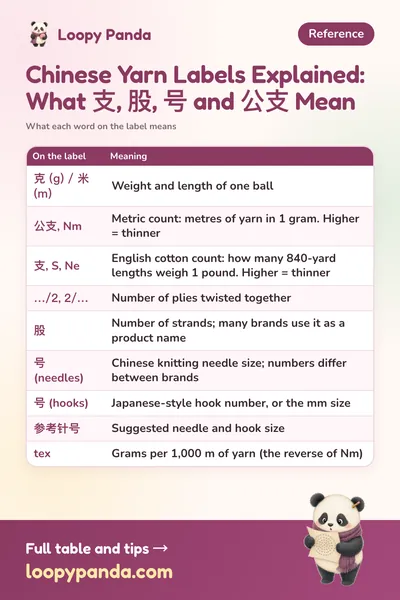
公支 (Nm) is how many metres one gram of yarn measures, so a higher number means thinner yarn. 支 on cotton usually means the English cotton count. 股 is the number of strands, and brands use it loosely, so it does not tell you thickness. 号 is a needle or hook size. The most reliable figure is metres per 100 g.
What each word on the label means
| On the label | Meaning | Example |
|---|---|---|
| 克 (g) / 米 (m) | Weight and length of one ball | 50克/125米 = 50 g ball, 125 m long |
| 公支, Nm | Metric count: metres of yarn in 1 gram. Higher = thinner | Nm 2.5 = 2.5 m per gram (250 m per 100 g) |
| 支, S, Ne | English cotton count: how many 840-yard lengths weigh 1 pound. Higher = thinner | 32支 (32S) ≈ Nm 54 |
| …/2, 2/… | Number of plies twisted together | 2/48Nm or 48Nm/2 = 2 plies of Nm 48, about Nm 24 overall |
| 股 | Number of strands; many brands use it as a product name | 4股棉, 8股牛奶棉 |
| 号 (needles) | Chinese knitting needle size; numbers differ between brands | 9号棒针 |
| 号 (hooks) | Japanese-style hook number, or the mm size | 5/0号 = 3.0 mm; 3.0mm钩针 |
| 参考针号 | Suggested needle and hook size | 钩针3.0mm-3.5mm 棒针9号 |
| tex | Grams per 1,000 m of yarn (the reverse of Nm) | tex = 1000 ÷ Nm |
公支 (Nm): metres per gram
公支, short for 公制支数, is the metric count. A Chinese textile industry association defines it as the length in metres of 1 gram of yarn, and ISO 1144 gives the same system as kilometres per kilogram. The bigger the number, the thinner the yarn. Yarns for fabric and industry have large counts; hand-knitting yarns have small ones.
- Plied yarns. The ply count is written with a slash, and mills put it on either side: 2/48Nm, 48Nm/2 and Nm 48/2 all mean 2 plies of Nm 48. Two plies of Nm 48 together give about Nm 24 (48 ÷ 2), that is about 2,400 m per 100 g.
- tex. Tex is the reverse: grams per 1,000 m, so tex = 1000 ÷ Nm. According to 科普中国, tex is China's legal unit for yarn thickness, although shops still use 支.
- Moisture. Counts are officially measured at a standard moisture content, so the metres and grams on a ball give only an approximate Nm.
支 on cotton: the English cotton count
When cotton is sold as 21支 or 32支, the number is usually the English cotton count (Ne, also written S): how many 840-yard lengths of yarn weigh one pound. It is also “higher = thinner”, but it is a different unit from 公支.
- Convert Ne to Nm: 840 yd × 0.9144 m = 768.1 m; 768.1 m ÷ 453.6 g = 1.693. So Nm ≈ 1.693 × Ne.
- Examples: 21支 ≈ Nm 36; 32支 ≈ Nm 54.
- These counts describe the single yarn used for fabric and sewing thread. They are not a hand-knitting thickness grade, and hand-knitting labels rarely show them.
股: strands, not thickness
股 means strands or plies. On hand-knitting yarn, especially cotton and 牛奶棉, brands use it as part of the product name, and the number does not tell you how thick the yarn is. The official account of the Chinese yarn database 编织人生 says thickness cannot be judged from the number of strands alone, and gives its own example: its 8-strand cotton is thinner than its 4-strand cotton. In another brand's range, the 8-strand line is the thickest. Compare metres per 100 g instead.
Work out the thickness yourself
The one number that works across brands and countries is metres per 100 g: metres ÷ grams × 100. The higher it is, the thinner the yarn. For example, a ball of 50克/125米 is 125 ÷ 50 × 100 = 250 m per 100 g (Nm 2.5).
| Label (maker's own figures) | m per 100 g | Weight on the label |
|---|---|---|
| Patons Kroy Socks, 50 g / 152 m | 304 | 1 Super Fine |
| Bernat Baby Sport, 350 g / 1148 m | 328 | 3 Light (DK) |
| Patons Grace, 50 g / 125 m | 250 | 3 Light (DK) |
| Red Heart Super Saver, 198 g / 333 m | 168 | 4 Medium (worsted) |
| Bernat Velvet, 300 g / 288 m | 96 | 5 Bulky |
| Bernat Blanket, 150 g / 98 m | 65 | 6 Super Bulky |
The Craft Yarn Council defines yarn weights 0–7 by gauge and hook size, not by metres per 100 g, and the examples above show the ranges overlap: a yarn labelled 3 can have more metres per 100 g than one labelled 1. So use metres per 100 g to compare a Chinese yarn with a yarn you know, and use the suggested hook on the label (参考针号) to place it on the yarn weight chart.
号 on needles and hooks
- Knitting needles (棒针). On the one brand chart we could find (三燕), the needles get thinner as the number goes up: 6号 is about 5.0 mm, 10号 about 3.25 mm and 16号 about 1.5 mm. There is no national standard, and brands differ, so always go by the mm.
- Crochet hooks (钩针). Labels and patterns usually give the hook in mm, such as 钩针3.0mm. A number like 5/0 or 7/0 is the Japanese system; see Japanese and Korean hook sizes.
Common Chinese yarn names
- 牛奶棉 (milk cotton). A trade name, not a fibre. The labels we checked are cotton blended with acrylic, “milk fibre” or modal. Milk fibre is made from milk protein (casein) combined with acrylic. Read the composition line (成份).
- 冰条线 (ice ribbon yarn). A thick, smooth yarn. One example, 如意鸟 小冰条, is polyester, 160 g / 104 m (65 m per 100 g), about 6 mm thick, for a 4–4.5 mm hook.
- 冰丝 (ice silk). A different thing: a trade name for several man-made fibres, mainly viscose and nylon. Do not confuse it with 冰条线.
Frequently asked questions
What does 支 mean on yarn?
It is a yarn count. On cotton, 21支 or 32支 is usually the English cotton count (840-yard lengths per pound); 公支 is the metric count (metres per gram). For both, a higher number means thinner yarn.
What does 公支 mean?
Metres of yarn in one gram. Nm 2.5 means 2.5 m per gram, which is 250 m per 100 g.
Is 8股 yarn thicker than 4股?
Not necessarily. 股 is the number of strands, and brands use it as a product name. Compare metres per 100 g instead: fewer metres per 100 g means thicker yarn.
What is 2/48Nm yarn?
Two plies of Nm 48 twisted together, about Nm 24 overall, or roughly 2,400 m per 100 g. That is very fine yarn, far thinner than hand-knitting yarn.
What is milk cotton yarn (牛奶棉)?
A trade name for soft cotton blends. The labels we checked mix cotton with acrylic, milk fibre or modal, so read the composition on the label.
What hook do I use for a Chinese yarn?
Use the suggested hook on the label (参考针号), which is usually in mm. For amigurumi, go smaller than the label suggests.
Save it for later
Pin this guide to your Pinterest board so it's there when you pick up your hook.
Save to Pinterest
Tell me when new free patterns are out
We'll send you a short email when a new free pattern or tutorial goes up. No spam.
Thank you! You're on the list. We'll email you when a new free pattern is out.
Please enter a valid email address.
Please tick the box to agree to receive our emails.
Too many tries. Please wait a few minutes and try again.
Something went wrong. Please try again later.
New short videos every week, too, on YouTube