 Loopy Panda
How Much Yarn Do I Need for a Crochet Project?
Crochet a swatch of at least 15 × 15 cm in your yarn and stitch, weigh it, and multiply: grams needed = swatch grams ÷ swatch area × project area. As a rough guide from real patterns, a worsted throw takes about 1,550–2,900 m (1,700–3,200 yd) and an adult hat about 110–275 m. Buy an extra ball.
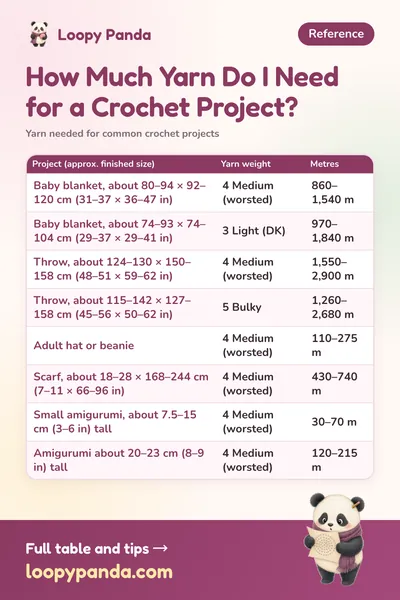
Yarn needed for common crochet projects
These ranges are the smallest and largest amounts in free crochet patterns published by the yarn maker Yarnspirations (Red Heart, Bernat, Caron, Patons, Lily), for projects of about the sizes shown. They are estimates: your stitch, tension and size change the amount a lot, so treat them as a starting point and check the pattern or yarn label.
| Project (approx. finished size) | Yarn weight | Metres | Yards | Patterns |
|---|---|---|---|---|
| Baby blanket, about 80–94 × 92–120 cm (31–37 × 36–47 in) | 4 Medium (worsted) | 860–1,540 m | 950–1,680 yd | 7 |
| Baby blanket, about 74–93 × 74–104 cm (29–37 × 29–41 in) | 3 Light (DK) | 970–1,840 m | 1,065–2,010 yd | 5 |
| Throw, about 124–130 × 150–158 cm (48–51 × 59–62 in) | 4 Medium (worsted) | 1,550–2,900 m | 1,700–3,170 yd | 10 |
| Throw, about 115–142 × 127–158 cm (45–56 × 50–62 in) | 5 Bulky | 1,260–2,680 m | 1,380–2,930 yd | 10 |
| Adult hat or beanie | 4 Medium (worsted) | 110–275 m | 125–300 yd | 8 |
| Scarf, about 18–28 × 168–244 cm (7–11 × 66–96 in) | 4 Medium (worsted) | 430–740 m | 470–810 yd | 6 |
| Small amigurumi, about 7.5–15 cm (3–6 in) tall | 4 Medium (worsted) | 30–70 m | 35–75 yd | 7 |
| Amigurumi about 20–23 cm (8–9 in) tall | 4 Medium (worsted) | 120–215 m | 135–235 yd | 4 |
Use metres or yards, not grams, to compare yarns: yarns of the same weight class can differ a lot in how many metres are in 100 g. In the same patterns, worsted yarns ranged from 159 to 187 m per 100 g and bulky yarns from 63 to 194 m per 100 g. Some baby-blanket amounts are the number of whole balls the pattern tells you to buy, so they include leftovers.
The swatch method: work it out for your own project
This is the most reliable way, because it uses your yarn, your stitch and your tension.
- Crochet a square of at least 15 × 15 cm (6 × 6 in) in the stitch you will use. Cut the yarn and trim the tails.
- Weigh it on a kitchen scale.
- Grams needed = swatch grams ÷ swatch area × project area. Use the same units for both areas.
- Convert grams to balls with the yarn label (grams per ball), round up, and add extra for borders, joins and the tails you weave in.
- A bigger swatch gives a more accurate result: on a small swatch, a scale that reads to 1 g can be several per cent out.
Worked example
Example numbers: your 15 × 15 cm swatch weighs 12 g, and you want a 127 × 152 cm (50 × 60 in) throw.
Swatch area = 15 × 15 = 225 cm². Blanket area = 127 × 152 = 19,304 cm². Yarn = 12 ÷ 225 × 19,304 = 1,030 g. In 100 g balls, buy 11.
For comparison, one Red Heart pattern for a 127 × 152.5 cm throw uses 1,000 g of worsted yarn, which works out at about 11.6 g for a 15 × 15 cm piece of that fabric, so 12 g is a realistic swatch weight for worsted.
Changing the size: scale by area
Yarn goes with the area of fabric, so when you make a pattern bigger or smaller, multiply the yarn by the area ratio: (new width × new length) ÷ (old width × old length). Use the finished measurements from the pattern's schematic, not the size number.
- Example (sweater, size 38 to 56). Suppose the schematic shows size 38 with a finished chest of 96 cm and a length of 60 cm, and size 56 with a chest of 132 cm and a length of 66 cm, and size 38 needs 900 g.
- Width ratio = 132 ÷ 96 = 1.375. Length ratio = 66 ÷ 60 = 1.1. Area ratio = 1.375 × 1.1 = 1.51.
- Yarn for size 56 = 900 g × 1.51 ≈ 1,360 g. Round up to whole balls.
- Scaling by the chest alone would give 1,240 g (too little); scaling both width and length by the chest ratio would give 1,700 g (too much). Bodies get wider much faster than they get longer, so you need both measurements.
- For a blanket, the same rule applies: a blanket twice as wide and twice as long needs about four times the yarn.
Tips so you do not run out
- Buy all the yarn from the same dye lot (the lot number on the label). Different lots can be a slightly different colour.
- Buy at least one extra ball; unopened balls can often be returned or used for another project.
- Weigh your yarn after the first quarter of the project and multiply by four to check you have enough.
Frequently asked questions
How much yarn do I need for a crochet blanket?
For a worsted throw of about 127 × 152 cm (50 × 60 in), free patterns from one large yarn maker use about 1,550–2,900 m (1,700–3,200 yd). For your own stitch, weigh a swatch and scale it by area.
How much yarn for a crochet baby blanket?
In worsted yarn, patterns for a blanket of roughly 80 × 100 cm call for about 860–1,540 m (950–1,680 yd). Check your pattern, and buy one extra ball.
How many skeins do I need for a blanket?
Divide the metres (or yards) you need by the metres per ball on your yarn label, and round up. Do it in length, not grams, because balls of different yarns hold very different lengths.
How much yarn for a crochet hat?
An adult beanie in worsted yarn took about 110–275 m (125–300 yd) in the patterns we checked.
How much yarn for a small amigurumi?
A toy about 7.5–15 cm tall in worsted yarn took about 30–70 m in the patterns we checked, and one about 20–23 cm tall about 120–215 m.
If a size 38 top uses 300 g, how much for size 56?
Multiply by the area ratio of the finished pieces: (new width × new length) ÷ (old width × old length), using the pattern's schematic. There is no single answer without those measurements.
Save it for later
Pin this guide to your Pinterest board so it's there when you pick up your hook.
Save to Pinterest
Tell me when new free patterns are out
We'll send you a short email when a new free pattern or tutorial goes up. No spam.
Thank you! You're on the list. We'll email you when a new free pattern is out.
Please enter a valid email address.
Please tick the box to agree to receive our emails.
Too many tries. Please wait a few minutes and try again.
Something went wrong. Please try again later.
New short videos every week, too, on YouTube