 Loopy Panda
Crochet Gauge: Why Your Piece Is a Different Size from the Pattern
Gauge is how many stitches and rows fit in a 10 cm (4 in) square. Crochet a swatch at least 15 cm (6 in) wide in the pattern's yarn, hook and stitch, block it, then count the middle 10 cm. More stitches than the pattern means a smaller piece: go up a hook size. Fewer stitches: go down a size.
What you need
- The yarn you will use for the project
- The hook the pattern or yarn label recommends, plus one size up and down
- A rigid ruler or a gauge measuring tool
- Pins or stitch markers
How to make and measure a gauge swatch
- Read the gauge line in the patternIt looks like 14 sc and 16 rows = 10 cm (4 in). That means 14 single crochet (UK double crochet) across and 16 rows up in a 10 cm square, in the stitch named. Gauge changes with the stitch, so swatch in the stitch the pattern says, not just any stitch.
- Crochet a swatch bigger than 10 cmUse the same yarn and hook as the project and make a square at least 15 cm (6 in) across; bigger is more accurate. To find how many stitches that is, take the pattern gauge × 1.5: for 14 sts per 10 cm, work 21 stitches (14 × 1.5 = 21). For single crochet, chain one more than that, 22, and start in the 2nd chain from the hook. Work rows until the piece is about as tall as it is wide.
- Block it the way you will block the projectWash or wet it as you will the finished piece, lay it flat and let it dry completely. Swatches can grow when blocked, so measure afterwards. See the blocking guide for which method suits your yarn.
- Measure in the middleLay the swatch flat without stretching it. Place a ruler across the centre, away from the edges, where stitches are uneven. Mark 0 and 10 cm with pins and count the stitches between them, including half stitches. Then measure 10 cm up and count the rows. See how to count stitches and rows if the rows are hard to tell apart.
- Compare with the pattern and adjustIf your numbers match, start the project with that hook. If not, use the table below, change the hook one size, and make a new swatch. Keep your hands relaxed and let the hook do the adjusting, as explained in crochet tension too tight or loose.
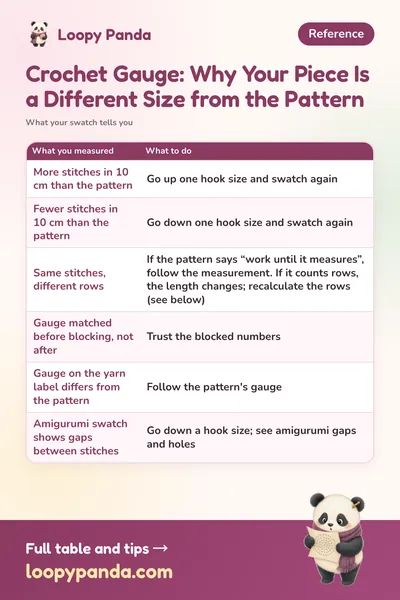
What your swatch tells you
Compare your blocked swatch with the gauge line in the pattern. Check the stitches first, then the rows.
| What you measured | What it means | What to do |
|---|---|---|
| More stitches in 10 cm than the pattern | Your stitches are smaller; the piece will come out smaller | Go up one hook size and swatch again |
| Fewer stitches in 10 cm than the pattern | Your stitches are bigger; the piece will come out bigger | Go down one hook size and swatch again |
| Same stitches, different rows | Width will be right, height will differ | If the pattern says “work until it measures”, follow the measurement. If it counts rows, the length changes; recalculate the rows (see below) |
| Gauge matched before blocking, not after | The yarn grows or shrinks when wet | Trust the blocked numbers |
| Gauge on the yarn label differs from the pattern | The label is a general guide for that yarn | Follow the pattern's gauge |
| Amigurumi swatch shows gaps between stitches | The fabric is too loose for a stuffed toy | Go down a hook size; see amigurumi gaps and holes |
B
e
t
w
e
e
n
2
.
2
5
a
n
d
6
.
5
m
m
,
o
n
e
h
o
o
k
s
i
z
e
i
s
a
s
t
e
p
o
f
0
.
2
5
–
0
.
5
m
m
;
s
e
e
t
h
e
<
a
h
r
e
f
=
"
/
t
e
c
h
n
i
q
u
e
s
/
c
r
o
c
h
e
t
-
h
o
o
k
-
s
i
z
e
-
c
h
a
r
t
/
"
>
h
o
o
k
s
i
z
e
c
h
a
r
t
<
/
a
>
.
Why a small gauge difference matters
Gauge is multiplied across the whole piece. A pattern that says 126 stitches for a 90 cm wide blanket at 14 sts per 10 cm will come out a different width if your gauge is different:
- Your gauge 15 sts per 10 cm: 126 ÷ 1.5 = 84 cm wide, 6 cm narrower.
- Your gauge 16 sts per 10 cm: 126 ÷ 1.6 = 78.75 cm wide, 11.25 cm (12.5%) narrower.
- The same applies to yarn: a looser gauge uses more yarn per stitch. For estimating yarn from a swatch, see the yarn calculator.
Formulas: from gauge to stitch and row counts
Work out how many stitches and rows fit in 1 cm (or 1 in), then multiply by the size you want. Do not round until the last step.
- Stitches per cm = stitches counted ÷ width measured (cm).
- Rows per cm = rows counted ÷ height measured (cm).
- Stitches needed = stitches per cm × width you want (cm).
- Rows needed = rows per cm × length you want (cm).
- Finished width = stitch count ÷ stitches per cm. Use this to check what size a pattern will come out at your gauge.
- Round to a whole stitch. If the stitch pattern repeats over a multiple (for example an even number), round to the nearest number that fits it. Then add the turning chain for the starting chain.
Worked examples
1. Your gauge from a swatch. You count 21 stitches across 15 cm: 21 ÷ 15 = 1.4 sts per cm, which is 14 sts per 10 cm.
2. Stitch and row counts for a blanket. Gauge 14 sc and 16 rows = 10 cm, so 1.4 sts and 1.6 rows per cm. For 90 × 120 cm: 1.4 × 90 = 126 stitches; 1.6 × 120 = 192 rows. In single crochet, chain 127 (126 + 1 turning chain) and start in the 2nd chain from the hook.
3. Your gauge is different from the pattern. The pattern was written for 14 sts per 10 cm, but your swatch has 16. Either change hook until you get 14, or recalculate with your gauge: 1.6 × 90 = 144 stitches for the same 90 cm width.
4. Working in inches. Gauge 16 sc = 4 in, so 16 ÷ 4 = 4 sts per inch. For 36 in wide: 4 × 36 = 144 stitches.
S
h
a
p
e
d
p
i
e
c
e
s
s
u
c
h
a
s
g
a
r
m
e
n
t
s
h
a
v
e
i
n
c
r
e
a
s
e
s
a
n
d
d
e
c
r
e
a
s
e
s
w
r
i
t
t
e
n
f
o
r
t
h
e
d
e
s
i
g
n
e
r
'
s
g
a
u
g
e
,
s
o
f
o
r
t
h
o
s
e
i
t
i
s
e
a
s
i
e
r
t
o
m
a
t
c
h
g
a
u
g
e
b
y
c
h
a
n
g
i
n
g
h
o
o
k
t
h
a
n
t
o
r
e
c
a
l
c
u
l
a
t
e
e
v
e
r
y
r
o
w
.
Gauge for amigurumi
Most amigurumi patterns do not need an exact gauge, and many crocheters skip the swatch for toys. What matters is that the fabric is dense and tight enough that the stuffing does not show. That is why toy makers usually go one or two hook sizes smaller than the yarn label suggests.
Size still follows hook and yarn: the same toy made with a larger hook comes out both taller and wider, and the gaps between stitches show more when it is stuffed. If you want your toy the same size as the pattern photo, use the yarn weight and hook the pattern gives, then check that no stuffing shows. See best yarn for amigurumi.
How to read the gauge on a yarn label
Many yarn labels show gauge as two small squares: one with knitting needles and one with a crochet hook. The size above or beside the square is the swatch size, usually 10 × 10 cm (4 × 4 in). The numbers along the bottom and side are stitches and rows, for example 6 sc and 8 rows, and the size inside the square is the recommended hook.
Some labels give only a knitting gauge. A knitting gauge does not tell you a crochet gauge, but the metric needle size is a reasonable starting hook size; swatch to check. The label is a general guide for the yarn: the Craft Yarn Council's yarn weight table, for example, gives 11–14 sc per 10 cm (4 in) and a 5.5–6.5 mm hook for medium (#4) yarn, and calls its figures guidelines only. When a pattern gives a gauge, follow the pattern. See the yarn weight chart for every weight.
Chart symbols on this page
Frequently asked questions
How big should a crochet gauge swatch be?
At least 15 × 15 cm (6 × 6 in) for a 10 cm (4 in) gauge, so you can measure the middle and leave out the uneven edges. Bigger gives a more accurate count.
If I have too many stitches, do I need a bigger or smaller hook?
Bigger. More stitches in 10 cm means your stitches are small, so go up one hook size. Too few stitches means go down one size.
Should I measure gauge before or after blocking?
After. Block the swatch the same way you will block the finished piece and let it dry completely, because swatches can grow when blocked.
What if my stitch gauge is right but my row gauge is off?
The width will be right and the length will differ. If the pattern gives lengths in cm, keep working until it measures right. If it counts rows, recalculate: rows per cm × length you want.
Do I need a gauge swatch for amigurumi?
Usually not. For toys the fabric must be tight with no gaps, so use a hook one or two sizes smaller than the yarn label. A different hook or yarn will make the toy a different size.
What does 14 sc and 16 rows = 4 in mean?
In a 4 × 4 in (10 × 10 cm) square of single crochet there should be 14 stitches across and 16 rows up. That is 3.5 stitches and 4 rows per inch.
Save it for later
Pin this guide to your Pinterest board so it's there when you pick up your hook.
Save to Pinterest
Tell me when new free patterns are out
We'll send you a short email when a new free pattern or tutorial goes up. No spam.
Thank you! You're on the list. We'll email you when a new free pattern is out.
Please enter a valid email address.
Please tick the box to agree to receive our emails.
Too many tries. Please wait a few minutes and try again.
Something went wrong. Please try again later.
New short videos every week, too, on YouTube