 Loopy Panda
Crochet Turning Chain Chart: How Many Chains for Each Stitch
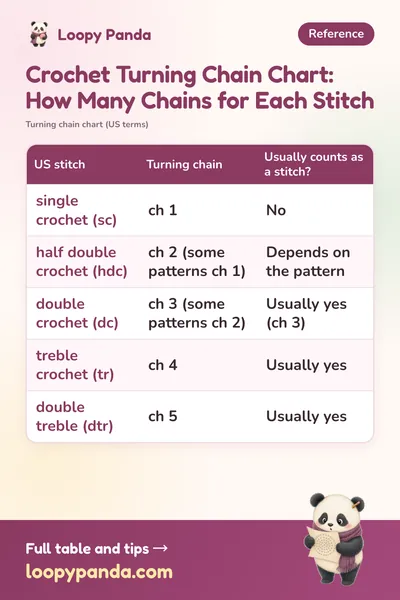
Chain 1 to turn for single crochet, 2 for half double crochet, 3 for double crochet, 4 for treble and 5 for double treble, because each stitch is about that many chains tall. The sc chain 1 does not count as a stitch; the dc and tr chains usually do. The hdc chain varies, so follow your pattern's note.
Turning chain chart (US terms)
A turning chain (in Japanese patterns, 立ち上がりのくさり, the “standing-up chain”) lifts the yarn to the height of the next row before you work its first stitch. The taller the stitch, the more chains you make. The same counts are used at the start of a joined round.
| US stitch | UK name | Japanese name | Turning chain | Usually counts as a stitch? | First stitch of the row goes into | Height |
|---|---|---|---|---|---|---|
| single crochet (sc) | double crochet (dc) | 細編み / こま編み | ch 1 | No | the first stitch | about 1 chain |
| half double crochet (hdc) | half treble (htr) | 中長編み | ch 2 (some patterns ch 1) | Depends on the pattern | the first stitch if it does not count; the second stitch if it counts | about 2 chains |
| double crochet (dc) | treble (tr) | 長編み | ch 3 (some patterns ch 2) | Usually yes (ch 3) | the second stitch | about 3 chains |
| treble crochet (tr) | double treble (dtr) | 長々編み | ch 4 | Usually yes | the second stitch | about 4 chains |
| double treble (dtr) | triple treble (trtr) | 三つ巻き長編み | ch 5 | Usually yes | the second stitch | the tallest of the five |
Watch the names: a UK pattern that says “treble” means a US double crochet, so it turns with ch 3, not ch 4. If a pattern is in UK terms, translate the stitch first (see US vs UK crochet terms), then read the chain count from the US column. The chart is the common convention, not a rule: some designers change it, and the pattern's own instruction always wins.
In Japanese patterns the rule is written down by the hook maker Clover: the standing chain (立ち上がり) counts as one stitch for half double crochet and taller stitches, and does not count for single crochet, because it is so short. See how to read Japanese crochet patterns.
When the turning chain counts as a stitch
If the pattern says the turning chain “counts as a stitch” (often written “ch 3 counts as dc”), the chain takes the place of the first stitch of the row. That changes two places in every row: you skip the first stitch (the one directly under the chain) and you work the last stitch into the top of the turning chain of the row below.
Example, 12 double crochet per row, ch 3 counts: chain 3 and turn (stitch 1). Skip the first dc, work 1 dc into each of the next 10 dc (stitches 2 to 11), then work the last dc into the top chain of the ch 3 from the previous row (stitch 12). You have 12 stitches again.
Example, 12 single crochet per row, ch 1 does not count: chain 1 and turn. Work 1 sc into the first stitch, right next to the chain, and 1 sc into each stitch to the end: 12 sc. Do not work into the ch 1 at the end of the row.
Mixing the two methods is the usual reason a piece grows or shrinks at the edges: working into the first stitch when the chain already counts adds a stitch, and missing the top of a counted chain loses one. See why is my crochet getting wider for how to find and fix it.
Why patterns disagree
Whether a turning chain counts is a convention, so it differs between designers and between pattern traditions. Read the pattern notes, and check your stitch count after the first few rows: it tells you which method the pattern uses.
- Half double crochet. Many US tutorials chain 2 and do not count it, working the first hdc into the first stitch. Others count the ch 2 as the first hdc, and some patterns turn hdc rows with just ch 1. Japanese patterns usually treat the 2 chains as the first 中長編み.
- Double crochet with ch 2. A counted ch 3 leaves a gap next to the first stitch, so some designers chain 2 instead, say it does not count, and work the first dc into the very first stitch.
- Single crochet. Here the conventions agree: the ch 1 does not count. In Japanese charts too, the standing-up chain plus the first sc together make the first stitch.
- Chainless starts. Some crocheters replace the ch 3 with a “stacked” single crochet (2 sc worked on top of each other, about as tall as a dc), or draw up a long loop and work a chainless first dtr. In single crochet rounds you can also skip the turning chain and the join entirely and mark the first stitch instead (stitch markers). Use these only where the pattern's stitch count still works out.
Chart symbols on this page
Frequently asked questions
How many chains do you turn with for each crochet stitch?
In US terms: 1 for single crochet, 2 for half double, 3 for double, 4 for treble and 5 for double treble. The number roughly matches the height of the stitch.
Does the turning chain count as a stitch?
In single crochet, no. In double and treble crochet it usually does, so you skip the first stitch and work the last stitch into the top of the turning chain. In half double crochet it depends on the pattern.
Does chain 3 count as a double crochet?
In most patterns, yes. Some patterns chain 2 instead and say it does not count, which avoids a gap at the edge. Follow the pattern note.
Is it chain 1 or chain 2 for half double crochet?
Chain 2 is the most common, but some patterns use chain 1. Whether it counts also varies. Do whatever your pattern says, and do it the same way on every row.
How many chains do you turn with for a UK treble?
Three. A UK treble is a US double crochet, so it uses the ch 3 turning chain. A UK double treble is a US treble and uses ch 4.
What does 立ち上がり mean in a Japanese crochet pattern?
立ち上がり (tachiagari) is the turning or starting chain at the beginning of a row or round: 1 chain for 細編み (sc), 2 for 中長編み (hdc), 3 for 長編み (dc) and 4 for 長々編み (tr).
Save it for later
Pin this guide to your Pinterest board so it's there when you pick up your hook.
Save to Pinterest
Tell me when new free patterns are out
We'll send you a short email when a new free pattern or tutorial goes up. No spam.
Thank you! You're on the list. We'll email you when a new free pattern is out.
Please enter a valid email address.
Please tick the box to agree to receive our emails.
Too many tries. Please wait a few minutes and try again.
Something went wrong. Please try again later.
New short videos every week, too, on YouTube