 Loopy Panda
Why Does My Hand Hurt When I Crochet? What to Change
Hand pain while crocheting most often comes from gripping the hook and yarn too hard, tight stitches, thin hard hooks, a bent wrist and long sessions without breaks. Relax your grip, try a thicker or padded handle, keep your wrist straight and take short, frequent breaks. Numbness, tingling or pain that does not go away needs a doctor.
This page is general information, not medical advice
The tips below are common, low-risk changes to how you hold and use your tools, collected from health services, arthritis charities, occupational therapists and crochet teachers. They cannot tell you what is causing your pain. If your pain is strong, does not go away, or comes with any of the warning signs further down this page, stop crocheting and ask a doctor, physiotherapist, or a hand or occupational therapist.
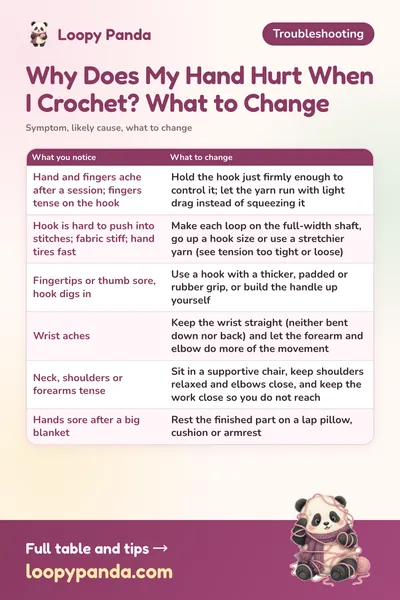
Symptom, likely cause, what to change
Find the row that sounds most like you. Change one thing at a time so you can tell what helps.
| What you notice | Likely cause | What to change |
|---|---|---|
| Hand and fingers ache after a session; fingers tense on the hook | Gripping the hook (and the yarn) too hard | Hold the hook just firmly enough to control it; let the yarn run with light drag instead of squeezing it |
| Hook is hard to push into stitches; fabric stiff; hand tires fast | Tension too tight, so every stitch takes more force | Make each loop on the full-width shaft, go up a hook size or use a stretchier yarn (see tension too tight or loose) |
| Fingertips or thumb sore, hook digs in | Thin, hard hook handle that you have to pinch | Use a hook with a thicker, padded or rubber grip, or build the handle up yourself |
| Wrist aches | Wrist held bent for a long time | Keep the wrist straight (neither bent down nor back) and let the forearm and elbow do more of the movement |
| Neck, shoulders or forearms tense | Slouching, unsupported back or arms, reaching for the work | Sit in a supportive chair, keep shoulders relaxed and elbows close, and keep the work close so you do not reach |
| Hands sore after a big blanket | Holding the weight of the project | Rest the finished part on a lap pillow, cushion or armrest |
| Ache builds the longer you crochet | Long sessions of the same small movements | Take smaller, more frequent breaks and do something with a different movement |
| Numbness, tingling, waking at night, weak grip, a finger that clicks or locks | Not a technique problem you should fix alone | Stop and see a doctor (see below) |
Pencil grip or knife grip: which hurts less?
There are two common ways to hold a crochet hook. In the pencil grip (underhand grip) you hold the hook the way you hold a pencil. In the knife grip (overhand grip) your hand is over the hook, like holding a knife to cut food. Both are correct, and crochet teachers agree there is no single right way: the right grip is the one you can crochet with comfortably.
No grip is proven to be better for sore hands. Some crocheters find one grip cramps their hand and the other does not, so if your hand hurts, it is reasonable to try the other grip on a small swatch. Whichever you use, hold the hook loosely and let your whole hand, wrist and forearm share the movement instead of working only with your fingertips.
Hooks and handles
A thin metal or plastic hook is fine for short sessions, but it can be hard on fingers and wrists, especially if you grip it tightly. A thicker handle needs less squeezing. Options:
- A hook with a padded, rubber or contoured (ergonomic) handle, or a ready-made enlarged grip.
- A home-made built-up handle: wrap the handle in tape, or mould polymer clay or foam tubing (pipe insulation) around it.
A
l
a
r
g
e
r
h
o
o
k
a
l
s
o
e
a
s
e
s
t
e
n
s
i
o
n
,
b
e
c
a
u
s
e
t
h
e
s
t
i
t
c
h
e
s
a
r
e
l
o
o
s
e
r
.
F
o
r
<
a
h
r
e
f
=
"
/
t
e
c
h
n
i
q
u
e
s
/
a
m
i
g
u
r
u
m
i
-
f
o
r
-
b
e
g
i
n
n
e
r
s
/
"
>
a
m
i
g
u
r
u
m
i
<
/
a
>
,
w
h
i
c
h
n
e
e
d
s
a
s
m
a
l
l
h
o
o
k
a
n
d
t
i
g
h
t
s
t
i
t
c
h
e
s
s
o
s
t
u
f
f
i
n
g
d
o
e
s
n
o
t
s
h
o
w
,
c
h
a
n
g
e
t
h
e
h
a
n
d
l
e
r
a
t
h
e
r
t
h
a
n
t
h
e
h
o
o
k
s
i
z
e
(
s
e
e
<
a
h
r
e
f
=
"
/
t
e
c
h
n
i
q
u
e
s
/
a
m
i
g
u
r
u
m
i
-
g
a
p
s
-
h
o
l
e
s
/
"
>
a
m
i
g
u
r
u
m
i
g
a
p
s
a
n
d
h
o
l
e
s
<
/
a
>
)
.
Yarn and tension
How tightly you hold the yarn matters as much as how tightly you hold the hook. Tight stitches mean more resistance on every stitch and more fatigue. If your stitches are tight, loosen the yarn wrap around your fingers, slide each new loop onto the shaft of the hook, and if needed go up one hook size or try a stretchier or thicker yarn for practice projects. A tension ring worn on one finger is an option if wrapping yarn around your fingers is uncomfortable.
Posture, support and breaks
Sit in a chair that supports your back; a seat that is too soft can push you into a slump. Keep your shoulders relaxed and your elbows close to your body. Have enough light to see your stitches without leaning forward. Support the work, for example on a cushion on your lap, so your hands are not holding the weight of a blanket. Advice on resting your arms differs: an NHS therapy leaflet recommends armrests or a supporting surface to steady your arms, while a hand therapy clinic warns that resting your arms on a table or chair arms can press on nerves. If your fingers tingle while your arms are resting on something, change position.
Break up long sessions. Smaller, more frequent breaks are better than one long break. During a break, change the movement: stand up, walk around, or gently stretch your hands and wrists only as far as is comfortable. One occupational therapist's advice for people with hand arthritis is to stand, walk or stretch for three to five minutes every 30 to 45 minutes. Do not crochet through pain to finish a row.
When to see a doctor
Stop crocheting and see a doctor (in the UK, a GP), or ask about a physiotherapist or hand therapist, if you have any of these:
- Numbness, tingling or pins and needles in your fingers, hand or wrist.
- Pain or tingling that wakes you up at night, or is worse at night.
- Weakness: a weak thumb or a weaker grip than normal.
- A finger or thumb that clicks, catches, gets stuck bent and then pops straight, or is stiff in the morning.
- Swelling, redness, stiffness or pain when you press the area.
- Severe pain, or pain after an injury.
- Pain that continues or does not get better, even after you have changed how you crochet.
T
h
e
s
e
c
a
n
b
e
s
i
g
n
s
o
f
n
e
r
v
e
o
r
t
e
n
d
o
n
p
r
o
b
l
e
m
s
t
h
a
t
n
e
e
d
a
p
r
o
p
e
r
e
x
a
m
i
n
a
t
i
o
n
.
A
c
l
i
n
i
c
i
a
n
c
a
n
t
e
l
l
y
o
u
w
h
a
t
i
s
g
o
i
n
g
o
n
a
n
d
w
h
e
t
h
e
r
i
t
i
s
s
a
f
e
t
o
k
e
e
p
c
r
o
c
h
e
t
i
n
g
.
D
o
n
o
t
r
e
l
y
o
n
s
t
r
e
t
c
h
e
s
,
b
r
a
c
e
s
o
r
a
n
e
w
h
o
o
k
t
o
f
i
x
t
h
e
m
o
n
t
h
e
i
r
o
w
n
.
Frequently asked questions
Is it normal for my hand to hurt when I crochet?
Occupational therapists advise treating pain as a signal to change something, not as something to push through. Relax your grip, check your tension, take breaks and try a thicker handle. If the pain does not go away, or you have numbness or tingling, see a doctor.
Which crochet grip is better for hand pain, pencil or knife?
Neither is proven to be better; both are correct ways to hold the hook. If one grip makes your hand cramp, try the other on a small swatch and keep whichever lets you hold the hook loosely.
Do ergonomic crochet hooks really help?
A thicker, padded or rubber handle means you do not have to pinch or squeeze as hard, which is why arthritis charities and NHS therapy leaflets suggest enlarged grips. You can also build up an ordinary hook with tape, polymer clay or foam tubing.
How often should I take a break when crocheting?
Smaller, more frequent breaks are better than one long one. There is no single proven schedule; one occupational therapist suggests standing, walking or stretching for three to five minutes every 30 to 45 minutes. Stop sooner if your hand starts to hurt.
Can crochet cause carpal tunnel syndrome?
Health services list repetitive hand and wrist work as a risk factor for carpal tunnel syndrome, but only a doctor can tell what is causing your symptoms. Numbness, tingling or pain at night are reasons to get checked.
Why do my fingers hurt more with amigurumi?
Amigurumi uses a small hook and tight stitches, which take more force. Keep the small hook for dense fabric, but try a thicker handle, a looser yarn hold and more frequent breaks.
Save it for later
Pin this guide to your Pinterest board so it's there when you pick up your hook.
Save to Pinterest
Tell me when new free patterns are out
We'll send you a short email when a new free pattern or tutorial goes up. No spam.
Thank you! You're on the list. We'll email you when a new free pattern is out.
Please enter a valid email address.
Please tick the box to agree to receive our emails.
Too many tries. Please wait a few minutes and try again.
Something went wrong. Please try again later.
New short videos every week, too, on YouTube