 Loopy Panda
Why Is My Granny Square Wavy, Twisted or Not Square?
A wavy granny square has too many stitches or chains for its size, and a cupped or curling one has too few or is worked too tightly. A square that turns into a circle is missing corner chains. A square that twists is leaning because you never turn; turn the work each round or block it flat.
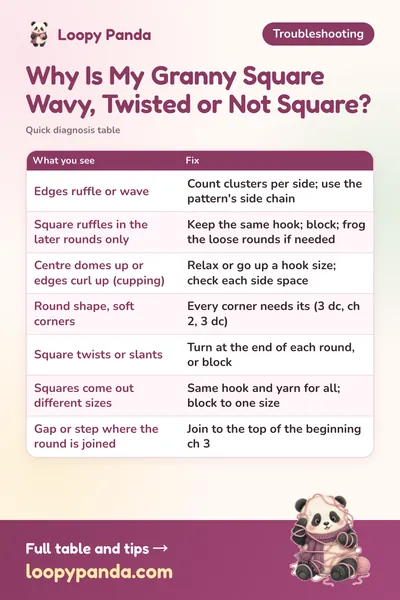
Quick diagnosis table
This page uses the classic granny square from our granny square tutorial: corners are (3 dc, ch 2, 3 dc) in one space, with ch 1 between clusters along the sides, and the square gains one cluster per side every round.
| What you see | Most likely cause | Fix |
|---|---|---|
| Edges ruffle or wave | Extra cluster on a side, or side chains longer than the pattern | Count clusters per side; use the pattern's side chain |
| Square ruffles in the later rounds only | Your stitches got looser as you relaxed, or you changed hooks | Keep the same hook; block; frog the loose rounds if needed |
| Centre domes up or edges curl up (cupping) | Tension too tight, or a missing side chain | Relax or go up a hook size; check each side space |
| Round shape, soft corners | Corner chain missing or shorter than the pattern | Every corner needs its (3 dc, ch 2, 3 dc) |
| Square twists or slants | Rounds worked without turning all lean the same way | Turn at the end of each round, or block |
| Squares come out different sizes | Tension changed between squares, or different yarn | Same hook and yarn for all; block to one size |
| Gap or step where the round is joined | Joined to the wrong stitch | Join to the top of the beginning ch 3 |
Why granny squares twist
When you work every round from the same side, each stitch leans slightly in the direction you work. In a square the lean adds up round after round, so the corners drift and the square looks turned. It is not a mistake. There are two ways to reduce it:
- Turn your work at the end of every round. After joining, turn the square over and work the next round in the other direction. The lean of one round cancels the lean of the next. The two faces of the square look slightly different, which is normal.
- Block the squares. Pin each square square to the same measurement and wet or spray block it. This fixes a mild twist, especially in cotton and wool. See the blocking guide.
How many chains in the corners and sides?
Corners need extra room to turn 90 degrees, and sides need only a small gap. The classic square uses ch 2 at the corners and ch 1 between side clusters. Some patterns use ch 1, ch 2 or ch 3 at the corners, and ch 1 or no chain on the sides. All of these work if you follow one pattern and do the same in every round. If your square ruffles, try a shorter chain; if the corners pull in and look round, make sure the corner chain is there in every corner.
Count clusters, not stitches
In the classic square, round n has 4 × n clusters and n − 1 ch-1 spaces on each side. Round 3 has 12 clusters and 2 side spaces per side. Counting side spaces is the quickest way to find the side with an extra or missing cluster.
Chart symbols on this page
Frequently asked questions
Why is my granny square wavy?
There are too many stitches or chains for the size: usually an extra cluster on one side, side chains longer than the pattern, or stitches that got looser. Count the ch-1 spaces on each side.
Why is my granny square a circle?
The corners are not getting enough room. Make sure every corner has its chain space, for example (3 dc, ch 2, 3 dc), and that you are working the corners into the corner spaces.
Why is my granny square twisting?
Rounds worked from the same side all lean one way, and the lean adds up. Turn the work at the end of each round, or block the finished squares.
Why is my granny square curling up?
Usually your tension is tighter than the pattern expects, so the edges pull in. Relax your hands or use a hook one size bigger, and check that no side chain is missing.
Can blocking fix a wonky granny square?
Blocking fixes mild twisting, curling and small size differences. It cannot fix a wrong number of clusters or a missing corner.
Save it for later
Pin this guide to your Pinterest board so it's there when you pick up your hook.
Save to Pinterest
Tell me when new free patterns are out
We'll send you a short email when a new free pattern or tutorial goes up. No spam.
Thank you! You're on the list. We'll email you when a new free pattern is out.
Please enter a valid email address.
Please tick the box to agree to receive our emails.
Too many tries. Please wait a few minutes and try again.
Something went wrong. Please try again later.
New short videos every week, too, on YouTube