 Loopy Panda
Can You Wash Amigurumi?
Yes. Spot clean first; if the toy needs a full wash, hand wash it gently in lukewarm water with mild detergent, press the water out in a towel and air dry. Acrylic and cotton toys whose yarn label allows machine washing can go in a mesh laundry bag on a gentle cycle. Wool usually needs hand washing.
How to hand wash amigurumi
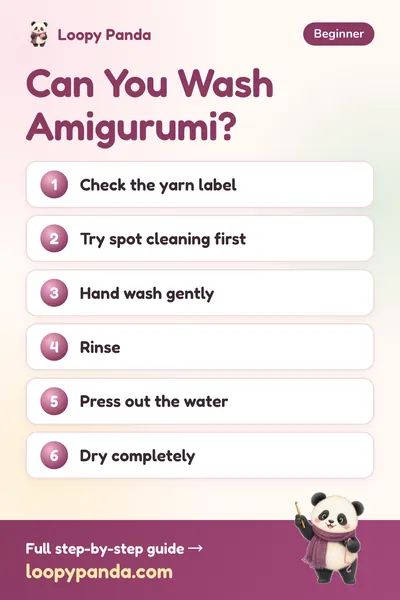
- Check the yarn labelThe yarn label tells you the maximum water temperature, whether a machine and a dryer are allowed, and whether colours may run. If the toy has more than one yarn, follow the most delicate label.
- Try spot cleaning firstDab the dirty spot with a damp cloth and a little mild detergent, then with clean water. The polyester stuffing maker Fairfield recommends spot cleaning to avoid the stuffing shifting or bunching.
- Hand wash gentlyDissolve a mild detergent in a bowl of lukewarm water and let the toy soak. Squeeze it gently under the water. Do not rub, wring or twist it. For wool toys, keep the water lukewarm and handle them as little as possible, because heat, moisture and agitation together make wool felt.
- RinseRinse in clean water of the same temperature until no soap comes out when you squeeze.
- Press out the waterRoll the toy in a clean towel and press. Do not wring it. Squeeze from the outside toward the openings rather than pulling limbs.
- Dry completelyAir dry in an airy place, turning the toy now and then, until it is dry inside as well as outside. Stuffed toys hold water in the middle, so give them time. If the stuffing has shifted, knead it back into place with your fingertips once the toy is dry.
Hand wash, machine wash or spot clean?
| Method | When to use it | How |
|---|---|---|
| Spot clean | Small marks; toys with glued parts, wire, or electronics | Damp cloth with mild detergent, then clean water |
| Hand wash | Any toy whose yarn can get wet; wool toys | Lukewarm water, mild detergent, no rubbing or wringing |
| Machine wash | Acrylic or cotton toys whose yarn label allows machine washing, with sewn-on parts | Mesh laundry bag, gentle or delicate cycle, water no warmer than the label allows |
| Do not wash | Toys with non-washable parts (cardboard, felt glued on, electronics) | Spot clean only |
Washing by yarn fibre
| Fibre | What labels usually allow | Watch out for |
|---|---|---|
| Acrylic | Many acrylic toy yarns can be machine washed; for example, Red Heart Amigurumi says cold water, gentle cycle, tumble dry low | Do not iron; high heat can permanently flatten acrylic |
| Cotton | Often machine washable on a delicate cycle; Lily Sugar'n Cream says no warmer than 30 °C | Some colours may run: wash multicolour toys cold and on their own |
| Wool (not superwash) | Hand wash and lay flat to dry; no machine dryer | Felting and shrinking, which cannot be undone |
| Superwash wool | Machine wash if the label allows; use a mesh laundry bag | Follow the label temperature |
The water temperatures in a wash-tub symbol are maximums. According to GINETEX, the care-labelling association, one bar under the tub means a milder cycle and two bars a very mild cycle, and the hand-wash symbol means no warmer than 40 °C. Your own yarn label always wins over this table.
Machine washing, step by step
- Only if every yarn in the toy allows machine washing, and all parts are sewn on or locked on securely.
- Put the toy in a zipped mesh laundry bag.
- Use a gentle or delicate cycle and the coolest temperature on any of the labels. Fairfield's stuffing tolerates warm water, but toy yarn labels are often stricter (Red Heart Amigurumi says cold).
- Use a mild detergent and no bleach.
- Air dry, or tumble dry on low only if every label allows it. Wool: never in the dryer.
Stuffing and safety eyes
- Polyester fibrefill can be washed. Fairfield says it may shift during washing; knead it back into place with your fingertips when the toy is completely dry.
- Safety eyes are held by a washer on the back. We found no safety-eye maker that says whether they survive a washing machine, so after any wash, pull on each eye and nose to check it is still firm.
- Glued parts (felt, glued-on eyes) may come off in water. Spot clean those toys.
Toys for babies and toddlers
Small parts are a choking risk for children under 3. The US Consumer Product Safety Commission bans small parts in toys for under-3s, including “removable small eyes and noses on stuffed toys”, and the European Commission advises not to buy toys with small detachable parts for children under 3. A safety-eye seller warns that the eye and washer “pose a choking hazard to small children and pets”. For a baby, we recommend embroidered eyes and features instead of safety eyes, and checking the toy after every wash and from time to time: remove or repair it if anything is loose or worn.
Frequently asked questions
Can you put amigurumi in the washing machine?
If the yarn label allows machine washing (many acrylic and cotton yarns do) and everything is sewn on securely, yes: put it in a mesh laundry bag on a gentle cycle at the label temperature or cooler. Wool toys should be hand washed.
Can you put amigurumi in the dryer?
Only if every yarn label allows tumble drying, and then on low. Air drying is safer for the shape. Never tumble dry non-superwash wool.
Will the stuffing go lumpy after washing?
Polyester stuffing may shift. Once the toy is completely dry, knead it with your fingertips to spread the stuffing out again.
Can you wash amigurumi with safety eyes?
Yes, by hand or on a gentle cycle in a mesh bag if the yarn allows. Check that the eyes are still firmly attached afterwards.
How do I dry amigurumi?
Press the water out in a towel, then air dry until it is dry all the way through, turning it now and then. Stuffed toys take longer to dry than flat pieces.
Is amigurumi safe for babies?
Make baby toys with no small parts that can come off: embroider the eyes and nose, sew parts on firmly, and check the toy regularly. Small parts are a choking risk for children under 3.
Save it for later
Pin this guide to your Pinterest board so it's there when you pick up your hook.
Save to Pinterest
Tell me when new free patterns are out
We'll send you a short email when a new free pattern or tutorial goes up. No spam.
Thank you! You're on the list. We'll email you when a new free pattern is out.
Please enter a valid email address.
Please tick the box to agree to receive our emails.
Too many tries. Please wait a few minutes and try again.
Something went wrong. Please try again later.
New short videos every week, too, on YouTube